

Part Two: Arrival
From the "Troop 13" series

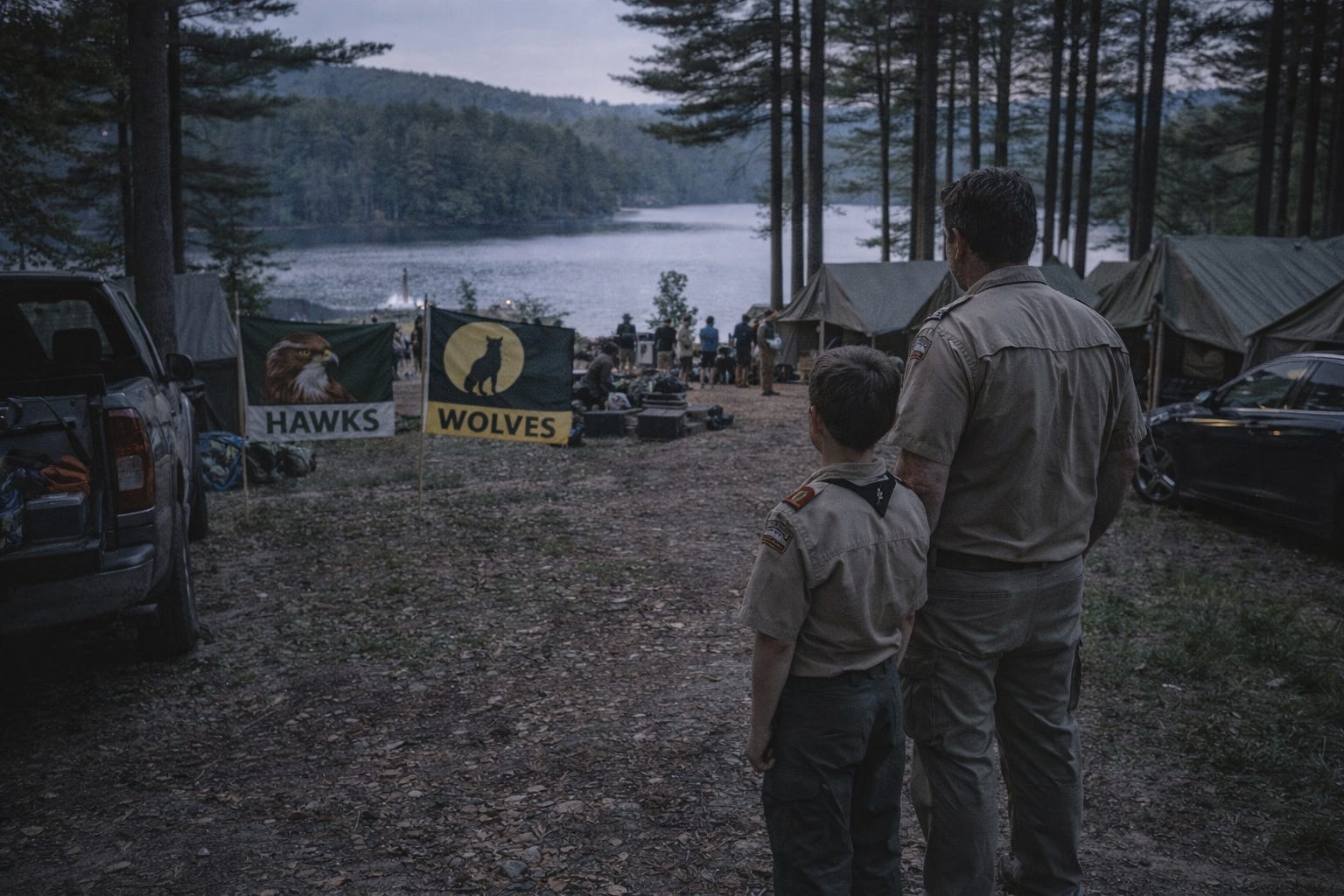
The drive to Camp Pinebrook was two hours north on roads that narrowed as the towns thinned out, the pavement going from four lanes to two lanes to a county route where the center line disappeared and the trees leaned in from both sides like spectators at a parade. Corey drove. Scott was in the passenger seat with his feet on his backpack and his face turned toward the window, watching the landscape change from strip malls and gas stations to dairy farms and then to forest, the deep northern forest that begins where the farms give up and the land decides to be itself.
Stash’s truck was ahead of them, loaded past the point of reason. The truck carried the troop’s communal gear, the patrol boxes, the cooking kits, the tarps, the dining fly, the folding tables, and a canvas duffel bag that belonged to Stash and that had been on every campout for a decade and that smelled, according to Parker, like “a wet dog that ate a campfire.” The truck also carried Parker and Diego, who had begged to ride with Stash because Stash let them sit in the bed when the road was slow, which was against every regulation Corey could name but which he had decided, after brief internal deliberation, to address at a later time, the later time being never.
Behind Corey’s car was Nick’s sedan, carrying Nicholas and Owen and Avery. Nick had taken vacation days for this. Five vacation days. A police officer in his early forties, with seniority and accrued time and the option to spend a week in July doing anything he wanted, had chosen to spend it sleeping on a platform tent in the woods with twelve boys. His sergeant had asked him why. Nick had said, “It’s for my son’s Scout troop.” The sergeant, who had known Nick for fifteen years, had looked at him with the expression of a man who knew a partial truth when he heard one and who also knew that Nick Testa did not explain himself further than he chose to, and the sergeant had approved the days without follow-up.
The caravan moved north. The road climbed. The air through the open windows changed from the flat, warm air of the valley to something cooler and sharper, air that tasted like pine and distance and the specific promise of a week in the woods, which is the promise that everything you know will be temporarily replaced by everything you don’t.
Scott had not spoken for twenty minutes. This was not unusual. Scott’s silences were not empty silences. They were full silences, the silences of a boy who was processing at a speed that did not require narration. Corey had learned to read them the way he read student work: not by what was on the page but by what the page was holding back.
“You okay?” Corey asked.
Scott nodded without turning from the window.
“Excited?”
“Kind of.”
“Kind of” was Scott’s entire emotional register compressed into two words. Kind of excited. Kind of nervous. Kind of wondering what a week away from the apartment and Danny’s burned toast and the kitchen table with the binder would feel like, what it would mean to sleep in a tent for six nights with boys who were louder and faster and more comfortable in the world than he was, what it would be like to be his father’s son at a place where his father was the scoutmaster and everyone knew it and there was no apartment to go home to at the end of the night. Kind of.
“It’s going to be a good week,” Corey said.
Scott turned from the window. He looked at his father. The look was the look of an eleven-year-old who wanted to believe something and was searching the face of the person who had said it for evidence. He found whatever he found. He turned back to the window.
“Okay,” Scott said.
* * *
Camp Pinebrook occupied three hundred acres on the western shore of Alder Lake, on land that had been donated to the council in 1938 by a family who had made money in lumber and felt guilty about the trees. The camp had a waterfront, a dining hall, a parade ground, an archery range, a rifle range, a nature lodge, a handicraft shelter, and approximately forty platform tents arranged in clusters along trails that wound through the pines. It was beautiful in the way that Scout camps are beautiful: with effort, with decay, with the stubborn persistence of an institution that believed in itself more than its budget could support.
The dining hall was the largest structure, a timber-frame building with exposed beams and a stone fireplace and a screen door that slammed with a report that could be heard from the waterfront. The tables inside were long and wooden and had been carved by forty years of scouts with pocketknives, the tabletops a palimpsest of initials and troop numbers and declarations of loyalty to girls whose names had changed and camps that had closed. The kitchen behind the serving window was staffed by two women from the town who had been cooking at Pinebrook for a combined thirty-seven years and who viewed the weekly arrival of new troops the way air traffic controllers view incoming flights: with practiced calm and the expectation of turbulence.
The waterfront was a dock, a swimming area marked by buoy lines, a rowboat rack, and a lifeguard chair that leaned at an angle suggesting either artistic intent or structural failure. The lake was cold. The lake was always cold, even in July, because the lake was spring-fed and deep and the springs did not care about the calendar. Boys would learn this at the first swim check. They would forget and relearn it every morning.
The latrines were an experience that Corey chose not to preview. He had been told, by a scoutmaster at the camporee, that the latrines at Pinebrook were “rustic,” which was a word that, when applied to bathrooms, meant something different than when applied to furniture.
* * *
Check-in was at the parking lot, which was a gravel rectangle at the bottom of the hill. A table had been set up with clipboards and folders and a hand-lettered sign that said WELCOME TO CAMP PINEBROOK in the uneven capitals of a staff member who had been given a marker and a piece of poster board and no further instruction.
The man behind the table was Walt Gunderson. He was in his sixties, short, with a white beard and a tan that was not the tan of a man who goes to the beach but the tan of a man who has been outside for forty years and whose skin has simply accepted the sun as a permanent condition. He wore a camp staff shirt that had been washed so many times the logo was a suggestion rather than a statement. His hat was a crushable wide-brim that had been crushed. His boots were the boots of a man who had hiked every trail on the property and most of the ones that weren’t trails and who considered the distinction between trail and not-trail to be administrative rather than practical.
Walt looked up when the caravan pulled in. He looked at Stash’s truck, which was leaking something from its undercarriage. He looked at the boys climbing out of the vehicles with the uncontained energy of children who had been sitting for two hours and who were now free. He looked at Corey, who was walking toward the table in clean hiking pants and a shirt that had been pressed, because Corey pressed things, because that was who Corey was, even when the destination was a campsite in the woods.
“Troop number,” Walt said.
“Troop 13.”
Walt’s face did something. It was the same something Corey had seen at training, at the camporee, every time he said his troop number to someone who had been in scouting long enough to have heard the stories. The microadjustment. The faint reorganization of features. But Walt’s version was different from the others, because Walt had been running this camp for twenty-two years and had seen every troop in the council pass through, including Troop 13 under Stash, and Walt’s microadjustment contained not just recognition but memory. Specific memory. The kind of memory that camp directors accumulate over decades and share with each other in the off-season, stories that begin with “You won’t believe what happened in Site 4” and end with the name of a troop that will not be invited back.
“New scoutmaster,” Walt said, looking at Corey. It was not a question.
“Since March of last year.”
Walt nodded. He pulled a folder from the stack and handed it to Corey. The folder contained the week’s schedule, the merit badge signup sheets, the health forms, the emergency procedures, and a map of the camp that looked like it had been photocopied from a photocopy of a photocopy, each generation losing resolution until the trails were suggestions and the buildings were approximations and the lake was a shape that could have been a lake or a large potato.
“Site 14,” Walt said. “Up the hill, past the nature lodge, follow the trail to the left. You’ll see the sign. It’s the farthest site from the dining hall, which means your boys will be late for every meal and you’ll need to account for travel time in your schedule.”
“Is there a closer site available?”
Walt looked at Corey over the tops of his glasses, which were not reading glasses but prescription glasses that he wore on his nose the way a professor wears them: low, skeptical, a physical manifestation of the question he was not going to ask out loud, which was: are you serious?
“No,” Walt said.
Corey took the folder. Behind him, Stash was already unloading the truck, tossing gear onto the gravel with the familiar disregard. Nick was organizing the boys into a line, because Nick organized things into lines, because lines were orderly and orderly was the only condition Nick trusted.
Walt looked past Corey at the troop assembling in the parking lot. His eyes moved across the boys, across Stash and his truck, across Nick and his line, and settled on the patrol flags that Corey was carrying in their tubes under his arm.
“What are those?” Walt asked.
“Patrol flags.”
“You brought patrol flags to summer camp?”
“The boys made them. I designed them.”
Walt looked at the tubes. He looked at Corey. He had been sitting at this table since before some of these boys’ parents were born, and in all that time the scoutmasters who walked up to it had a certain look. This one did not have that look. This one had pressed pants and patrol flags in art-supply tubes, and Walt studied him the way a man studies weather he has not seen before—not with alarm, but with the careful attention of someone who has learned that the unfamiliar is worth watching.
“Huh,” Walt said. It was a single syllable that contained an entire reassessment. “Welcome to Pinebrook.”
* * *
Site 14 was, as advertised, at the far end of everything. The trail climbed past the nature lodge, past the handicraft shelter, past three other troop sites where camps were already established and boys were already running and adults were already standing near coolers with the glazed patience of people who had arrived earlier and were further along in the process of surrender. The trail turned left and descended into a stand of white pines, and the pines opened into a clearing with six platform tents, a fire ring, a picnic table, and a view of the lake through the trees that was, Corey had to admit, worth the walk.
The platform tents were wooden floors raised two feet off the ground with canvas walls and roofs and screened openings that let in air and bugs in equal proportion. Each tent slept four. The canvas was old. The screens had patches. The floors had the soft give of wood that had been rained on and dried and rained on again for decades, and the whole structure had the honest decrepitude of something that had served its purpose for a long time and intended to keep serving it regardless of what anyone thought about its appearance.
The boys chose tents with the diplomatic complexity of a United Nations seating chart. Parker and Diego together, which was a given, because Parker and Diego were inseparable in the way that twelve-year-old boys are inseparable: loudly, completely, until they were not. Owen by himself, or rather, Owen in a tent with Avery, who was quiet enough that Owen’s silence would not be crowded. Scott was assigned to the Hawks’ tent with Nicholas, which meant Scott would spend the week sleeping six feet from a sixteen-year-old who shaved and drove and occupied a category of boyhood that Scott had not yet imagined.
Corey and Nick took the adults’ tent, the one farthest from the boys, which was a distance of approximately thirty feet, which was not far enough to provide privacy but was far enough to establish the boundary between the adult world and the boy world, a boundary that existed in theory and dissolved in practice every time a flashlight went on after lights-out or a voice carried through the screens saying something that contained the word “fart” and the sound of laughter that followed.
Stash was not staying at Site 14. Stash was staying in his truck, in the parking lot, because Stash’s truck had a cap on the bed and a sleeping pad that had been there for years and because Stash preferred the parking lot to the campsite, which was a preference that made sense only if you knew Stash, and if you knew Stash it made perfect sense. He would be at the site during the day. He would help with meals and fires and the things Stash helped with. At night he would retreat to the truck, which was Stash’s version of home, portable and self-contained and answerable to nobody. Corey had stopped questioning this arrangement. The arrangement worked. Stash was reliable in his unreliability, consistent in his inconsistency, and the truck in the parking lot was as much a part of Troop 13’s infrastructure as the patrol flags and the binder.
* * *
The camp staff appeared in stages, the way characters appear in a play: first the background, then the principals. The background was a collection of sixteen- to eighteen-year-olds in matching staff shirts who moved through the camp with the ownership of people who had been here for weeks and who viewed the arriving troops the way upperclassmen view freshmen: with tolerance, with superiority, with the faint nostalgia of people who remember being new and are glad they are not.
The first principal was Bryce.
Bryce appeared at Site 14 within fifteen minutes of the troop’s arrival, walking up the trail with a clipboard and a staff shirt that had been tucked in with a precision that would have impressed Karen McKay. He was seventeen, tall, thin, with the posture of someone told that posture communicated character, having taken the instruction literally. His name tag said BRYCE and beneath it said PROGRAM AIDE, which was a title that existed in the camp’s hierarchy and that Bryce wore the way a first lieutenant wears a bar: as evidence of rank, as promise of more rank, as proof that the system recognized his value.
“Welcome to Camp Pinebrook,” Bryce said, extending his hand to Corey. The handshake was firm. The handshake was practiced. The handshake was the handshake of a seventeen-year-old who had read an article about handshakes and was implementing its findings. “I’m Bryce. I’m your troop guide for the week. I’ll be your point of contact for scheduling, merit badge coordination, and any site-related issues. Here’s the orientation packet.” He handed Corey a folder that was identical to the one Walt had given him, except that Bryce’s folder had a sticky note on the front that said TROOP 13 — BRYCE in handwriting that was neat enough to frame.
Corey looked at the sticky note. He looked at Bryce. He recognized the type immediately, because the type existed in his classroom and in his troop and in every institution that involved young people trying to be taken seriously: the overperformer, the boy who had found a structure that rewarded effort and had decided to give it everything he had, not because the rewards were large but because the effort was the point. Bryce was the camp version of the student who sits in the front row and takes notes on the syllabus. Bryce was, Corey realized with a fondness he did not expect, a younger version of Corey.
“Thank you, Bryce,” Corey said. “This is very thorough.”
Bryce stood slightly taller, which should not have been possible given that he was already standing at maximum altitude. “If you need anything, I’m in the staff area behind the dining hall. Any time. I wake up at five-thirty.”
He walked down the trail with the stride of a person on his way to the next responsibility, and Corey watched him go and thought: that boy is going to run this camp in five years.
The second principal was Kelsey.
Kelsey did not appear at Site 14. Kelsey was at the nature lodge, and the nature lodge was where Kelsey stayed, because the nature lodge was a building at the far end of the camp that contained terrariums and bird identification charts and a collection of animal skulls that had been accumulating since the 1970s, and the building was quiet and out of the way and had a porch with a view of the lake, and Kelsey had identified all of these qualities as advantages and had arranged her summer around them.
Corey encountered Kelsey when he walked the boys past the nature lodge on the way to the campsite. She was sitting on the porch in a camp staff shirt that had been altered, the sleeves rolled and the hem tied, modifications that were technically against uniform regulations and that Kelsey had made anyway because Kelsey had the energy of a person who acknowledged rules as a concept without granting them authority over her personal decisions. She was looking at her phone. She looked up when the troop passed and said, “Hey,” with the minimal effort of a greeting that is offered because it is required and not because it is felt.
“Are you the nature director?” Corey asked.
“I run the nature lodge. Director is a strong word.”
“What programs do you offer?”
Kelsey looked at Corey the way a person looks at someone who has asked a question that reveals they are new. “Nature stuff. Bird ID. Reptiles. Environmental science merit badge, which is mostly a worksheet. I also do a night hike on Wednesday if enough people sign up.” She paused. “Last week nobody signed up.”
“We’ll sign up,” Corey said.
Kelsey looked at him with faint surprise at acceptance. “Cool,” she said, and returned to her phone.
* * *
Site 12, two sites down from Troop 13, belonged to Troop 88 from downstate. Corey learned this in the first hour, because Troop 88 announced itself the way certain troops announce themselves: through volume, through gear, through the sheer acreage of their presence.
Their campsite was a production. They had a canopy over their cooking area. They had a troop banner printed on vinyl, professional quality, hung between two trees on a cable. They had matching camp chairs, matching water bottles, matching T-shirts that said TROOP 88 SUMMER CAMP 2024 on the front and BUILT DIFFERENT on the back. Their scoutmaster was a man in his fifties with a polo shirt and a watch that caught the sun and the bearing of someone accustomed to having things organized for him. He stood in the center of his campsite and directed the setup the way a contractor directs a build: with authority, with specifics, with the assumption that the materials were adequate and the labor was available.
His name, Corey would learn at the leaders’ meeting that evening, was Greg Pfeiffer. He was an investment banker. His troop was sponsored by a church in Westchester. The troop had thirty-two boys. They had brought twelve to camp, along with four adults, a troop trailer (smaller than Ted Callaway’s but newer), and a budget that was visible in every matching item and custom-printed banner and professional-grade canopy. Greg ran his troop the way he ran a portfolio: with resources, with strategy, calm, in the way of someone who had never been short of either.
Nick stood at the edge of Site 14 and looked down the trail at Troop 88’s campsite. He looked at the canopy. He looked at the banner. He looked at the matching chairs.
“Different kind of troop,” Nick said.
“Different kind of budget,” Corey said.
“Their banner cost more than our cooking kit.”
“Our cooking kit works.”
Nick looked at Corey. The look said he had been given the right answer and knew it. “Yeah,” he said. “It does.”
* * *
The first evening was orientation. Walt addressed the assembled troops at the parade ground, standing on a wooden platform that served as a stage and that had the structural integrity of a suggestion. He spoke without notes, without microphone, without the amplification of anything other than a voice that had been addressing boys in fields for twenty-two years and that carried the authority of a man who did not need to raise his voice because his voice had never needed raising.
He welcomed them. He explained the rules. The rules were brief: be where you’re supposed to be when you’re supposed to be there, respect the staff, respect the camp, respect each other, swim with a buddy, stay out of the waterfront after dark, and leave the camp better than you found it. He said these things the way a man says things he has said a thousand times and still means: with the worn sincerity of a truth that has been used so often it has become smooth.
He introduced the camp staff. Bryce stood at attention. Kelsey stood at something closer to tolerance. The lifeguards waved. The shooting sports director, a man named Pete who was roughly the size and shape of the rifle range, nodded. The dining hall cooks did not appear, because the dining hall cooks had dinner to make and did not attend assemblies, which was a tradition at Pinebrook and which Walt respected because the cooks outranked everyone, including Walt.
After the assembly, the troops dispersed to their sites. The boys had an hour of free time before lights-out. Free time at Scout camp, Corey was learning, was not free. It was the time in which boys found the boundaries of the place and tested them, quietly, systematically, the way water tests a dam. Parker and Diego were at the waterfront before Corey could say “the waterfront is closed.” Owen had found the nature lodge porch and was sitting on it, looking at the lake, and Kelsey was looking at her phone three feet away, and the two of them occupied the same space with the easy coexistence of two people who did not require conversation. Avery was exploring the trails. Nicholas was organizing his tent.
Scott was sitting on the platform of his tent, legs dangling over the edge, looking at the lake through the pines. The light was going. The lake was turning from blue to gray to the color that water becomes when the day gives up and the water stops pretending to be anything other than dark and deep and cold. Scott sat and watched it. His hands were on his knees. His face was the face of a boy who was somewhere new and was deciding, with the full weight of his eleven-year-old judgment, whether somewhere new was a place he could be.
Corey walked to the tent. He did not sit next to Scott. He stood nearby, close enough to be present, far enough to not crowd. This was the distance he had learned: the distance between a father who wanted to fix everything and a son who needed to feel things on his own. It was the hardest distance Corey had ever maintained. It was the distance the patrol method was built on. Let them struggle. Let them feel. Let them figure it out. The boys, Gary Furlong had said. The program works when the boys fail and learn.
But Gary Furlong had not been talking about Corey’s son. Gary Furlong had been talking about scouts. Corey was the scoutmaster. Scott was his scout. And the distance between those two facts and the fact that Scott was also his boy, his quiet boy, his anxious boy, the boy who positioned himself at the edges and watched the world from there, was a distance that no handbook had mapped and no training had prepared him for.
“Dad,” Scott said, without turning from the lake.
“Yeah.”
“The lake is really big.”
Corey looked at the lake. It was big. It was big in the way that things are big when you are eleven and everything is being measured for the first time, when a lake is not just a lake but a statement about the size of the world and your position in it.
“It is,” Corey said.
Scott was quiet for a moment. The pines moved. The lake held still.
“I think I’m going to like it here,” Scott said.
He said it the way he said everything: quietly, carefully, as if the words were being tested before they were released. I think I’m going to like it here. Not I like it. Not I love it. I think I’m going to. The future tense. The commitment to a feeling that had not yet arrived but that he could see approaching, the way you can see weather approaching across a lake, and Scott was sitting on the edge of his tent watching it come.
Corey stood in the pines and watched his son watch the lake and did not say anything, because anything he said would have been too much, and the moment did not need his words. It needed his presence, which was the only thing Corey had ever been truly good at giving: the act of being there, quietly, while someone he loved figured out where they were.
The light left. The lake went dark. From down the trail, the dining hall bell rang, a sound that carried across the camp the way bells have always carried, over water, through trees, into the spaces where people are waiting without knowing what they are waiting for. Dinner. The first meal. The first night. The week stretching ahead like the lake, big and cold and full of things that had not happened yet.
“Let’s go,” Scott said, and he jumped down from the platform and walked toward the trail, and Corey followed his son through the pines, toward the bell, toward the dining hall, toward the week.