

Camporee
From the "Troop 13" Series

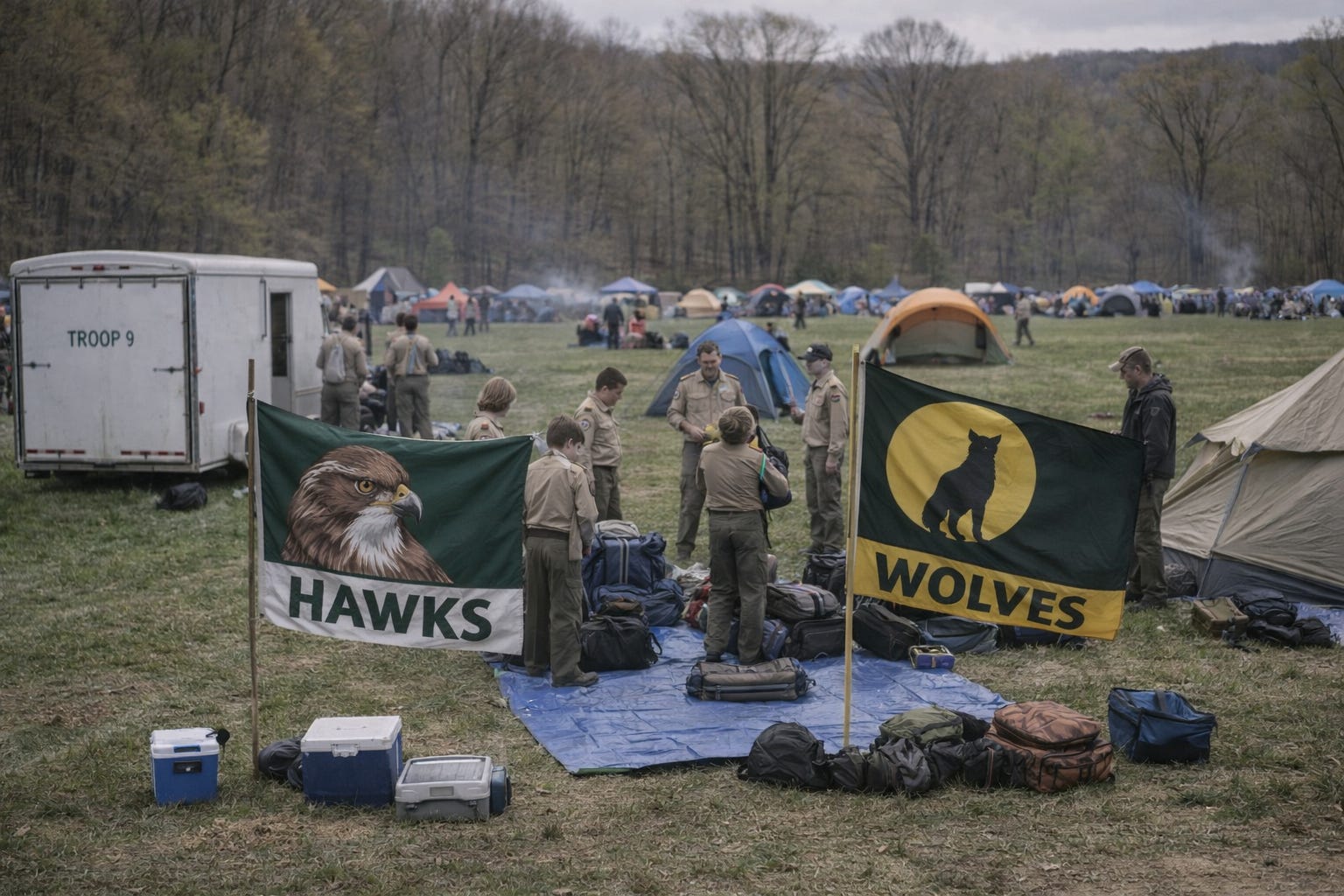
The Spring Camporee was held at Camp Mohegan, a council property on a hill above the river, on a Saturday in April. Fourteen troops were registered. Troop 13 had not attended a camporee in three years. Karen had mentioned this four times during the committee meeting, each time with the restrained fury of a woman who had been keeping a record of absences and was now presenting the bill.
They arrived in Stash’s truck and Corey’s car and Nick’s sedan. The truck led, because Stash always led, because leading was what Stash did when he was driving and following was what Stash did never. The truck carried the troop’s gear: the patrol stoves, the cooking kits, the tarps, the poles, the rope, and the two patrol flags that Corey had designed and the boys had painted. The flags were rolled in tubes that Corey had purchased from an art supply store, because Corey stored patrol flags the way he stored everything, which was carefully, and Stash stored things the way Stash stored things, which was in the bed of a truck between a spare tire and a tangle of bungee cords.
They pulled into the parking area and the boys got out and looked at Camp Mohegan and at the other troops and at the other troops’ gear, and a silence fell over them that was the silence of people arriving at a party and discovering that everyone else is better dressed.
Troop 9 had a trailer. Not a truck. A trailer, white, with their troop number painted on the side in professional lettering, towed by a Suburban driven by a parent who was not Ted Callaway but who parked with the same precision Ted Callaway would have parked with, because Ted Callaway’s influence extended to the driving habits of his troop’s parents. The trailer opened to reveal gear stored in labeled compartments: patrol boxes, color-coded; cooking kits, inventoried; tents in compression sacks, sorted by size. Three adults in matching khaki emerged from the Suburban. Their shirts were pressed. Their boots were clean. Their troop neckerchiefs were identical, forest green with a gold border, and they wore them with the unity of a team that understood that appearance was the first competition and they had already won it.
Troop 13 had Stash’s truck.
The boys looked at the trailer. They looked at the truck. Parker said, “That’s not fair,” which was the correct assessment, delivered without analysis, in the way that twelve-year-olds deliver correct assessments about the world: by stating the obvious and expecting someone to fix it.
Corey looked at the trailer too. He looked at the pressed shirts and the matching neckerchiefs and the color-coded patrol boxes and felt the specific inadequacy of hard work meeting the standard of what working very hard looks like when you’ve been doing it for twenty years with better equipment. Then he opened the tube and unrolled the Hawk Patrol flag, and he held it up, and the hawk on the flag looked back at him with the fierce indifference of a bird that did not care about trailers.
“Let’s set up,” Corey said.
* * *
The campsite assignments were posted on a board near the check-in table. Troop 13 was in Site 7, which was at the far end of the field, near the tree line, which was either the worst site or the most private, depending on your perspective. Corey chose to see it as private. Stash chose to see it as close to the woods, which meant close to firewood, which meant close to the thing Stash cared about most. Nick chose to see it as defensible, because Nick was a cop and cops saw everything as a perimeter.
They set up. The boys worked in patrols, which was new for a camporee and which Corey had insisted on because the patrol method was the foundation of everything they did, Gary Furlong had said so four times in one morning, and Corey had underlined it twice in his notebook, and the underlines had become practice and the practice had become habit and the habit was now the way Troop 13 operated. The Hawks put up their tents and their cooking fly and planted their patrol flag, the one with the hawk, and the flag snapped in the April wind with a crispness that caught the eye. The Wolves did the same with their flag, the one with the wolf silhouette against a yellow moon, and the wolf flag was, if anything, better than the hawk flag, because Corey had refined his technique between the first design and the second, and the refinement showed.
Nick organized the logistics. He inventoried the cooking kits. He confirmed the water source. He walked the site boundary and noted the proximity of the latrine and the distance to the central pavilion where the events would be held. He did all of this without being asked, because Nick did not wait to be asked, because waiting to be asked was Owen’s way—he did not see work until it was pointed out, and Nick saw everything.
Stash built a fire. He built it quickly, efficiently, with the same single-match technique he had used at the winter campout, and the fire was burning before most of the other troops had finished setting up their tents. Smoke rose from Site 7 and drifted across the field, and the smoke was an announcement, a signal that said: we are here, we are small, and we have fire.
Karen arrived in her own car. She parked in the lot and walked to the campsite carrying a tote bag and her clipboard and a folding chair that she set up at the edge of the site positioned to observe rather than participate, which was Karen’s preferred mode at any event: present, watching, recording.
She looked at the campsite. She looked at the patrol flags. She looked at the fire. She wrote something on the clipboard. She did not say anything, and the not-saying was louder than saying would have been, because Karen’s silence, when she chose it, was a room you could walk into and find things arranged in ways you did not expect.
* * *
Ted Callaway found Corey at the check-in table. Or rather, Ted Callaway arrived at the check-in table at the same time as Corey, because Ted Callaway did not find people. People found Ted Callaway, or they didn’t, and either way Ted Callaway’s day continued on schedule.
“Whitman,” Ted said. He was in uniform. The uniform looked like it had been issued that morning, creased and precise, the shirt tucked with geometric exactness, a sloppy tuck being a moral failing. His Wood Badge beads hung from the pocket. His belt had a buckle that was either an award or a weapon, possibly both.
“Ted.”
“You made it. First camporee for Troop 13 in, what, three years?”
“Three years.”
“Welcome back.” Ted said this the way a champion says welcome back to a team that has returned from the minor leagues: with courtesy, without concern. He glanced across the field toward Site 7, where Stash’s truck was visible and Stash’s fire was burning and Troop 13’s campsite was taking shape in its modest, uncoordinated way. His eyes moved across the site and stopped on something.
“Are those your patrol flags?”
“The boys painted them. I did the design.”
Ted looked at the flags. The hawk flag was visible from the check-in table, a hundred yards away, because Corey had designed it to be visible from a hundred yards away, because Corey understood visual communication the way Ted understood square lashings: instinctively, professionally, at a level that did not require explanation. The flag was bold, clean, the colors balanced. It did not look like a Boy Scout patrol flag. It looked like a piece of graphic design that happened to be hanging from a pole in a field.
Ted did not comment on the flags. He turned back to the check-in table and picked up his roster sheet and walked toward his campsite, where his matching-neckerchief, color-coded-patrol-box, trailer-owning troop was already set up and already winning the appearance category that existed in Ted’s mind as the first event of every camporee.
But he had looked at the flags. He had looked at them long enough for Corey to see him looking, and for Ted Callaway to look at something for more than two seconds was the equivalent of another man stopping in his tracks. The flags had landed. Corey filed this away the way he filed everything: quietly, without celebration, in the place where small victories are stored by people who know the war is long.
* * *
The camporee competition ran from ten in the morning to four in the afternoon. Six events, each scored by volunteer judges from the council. Fire building. Knot tying. First aid. Orienteering. Camp cooking. And a mystery event that would be revealed at two o’clock, because camporees loved mystery events the way game shows loved bonus rounds: as a mechanism for drama that was usually anticlimactic but occasionally electric.
Fire building. Stash was not allowed to help. This was the rule: the boys did the work. The Hawks built their fire lay, practiced since the winter campout, taught by Stash himself. It took them four minutes to get it lit, which was not fast, but the fire burned and the water boiled and the judges wrote a number on their clipboards that was neither the highest nor the lowest but was a number that existed in the middle of the range, which was where Troop 13 existed in most things: not at the top, not at the bottom, but present, competing, counted.
Troop 9 boiled their water in ninety seconds. Their fire building was a performance, rehearsed and executed with the synchronization of boys who had done this drill a hundred times. The judges wrote a number that was the highest number.
Knot tying. The boys stood at stations and tied knots on command. Square knot. Two half hitches. Taut-line hitch. Bowline. The bowline was the disaster Corey had anticipated, because the bowline was always the disaster, because the bowline was the knot that Corey could not tie and that his inability to tie had become, in the district’s collective memory, one of the defining characteristics of Troop 13’s scoutmaster. The boys tried. Scott tried hardest, his fingers working the rope with the focused intensity of a boy who had practiced at home, on the kitchen table, while his father sat across from him practicing the same knot with the same rope and achieving the same result, which was failure. Scott’s bowline did not hold. Neither did Diego’s. Parker tied something that he called a bowline and that the judge examined with the expression of a man looking at a word he could not pronounce.
Nicholas tied his bowline in four seconds. He tied it the way his father did things: correctly, without commentary, with the quiet competence of a person for whom competence was not a goal but a setting. The judge nodded. Nicholas moved to the next station.
First aid. Better. The boys had practiced this, and first aid was a skill that responded to practice rather than to natural ability. Diego, who was methodical by nature, scored well. The Hawks as a patrol scored in the top five, which was a result that Karen recorded on her clipboard with a checkmark that was, for Karen, the equivalent of a standing ovation.
Orienteering. Corey’s strength. The compass course was set across the hillside, and the boys moved through it with the spatial awareness that Corey had been teaching them since his own training, where Gary Furlong had discovered that the art professor who could not tie a bowline could read terrain like a topographer. Corey had taught the boys to read maps the way he read them: as compositions, as relationships between forms. The contour lines were not abstract. They were the shape of the land, and if you could see the shape, you could find the point. The Hawks finished the orienteering course second. Second out of fourteen troops. Nick, standing at the finish line with a stopwatch he had brought from home, looked at Corey with an expression that said: you did that.
Camp cooking was adequate. The Wolves made chili, and it was edible and hot, and the judges gave it a score that reflected edible and hot, which was fine.
* * *
The mystery event, announced at two o’clock by Glen Harriman in full uniform with a laminated card, was a patrol problem-solving challenge. Each patrol would be given a scenario and twenty minutes to devise and present a solution. The scenarios involved outdoor emergencies: a lost hiker, a water contamination, a campsite flood. The solution would be judged on creativity, teamwork, and adherence to scouting principles.
Glen read the rules from a laminated card. He was wearing his full uniform, pressed, with every patch aligned and every insignia polished, because Glen Harriman was a man who believed that the dignity of the institution was maintained through the precision of its presentation, and Glen’s presentation was always precise, even when the institution was fourteen troops of boys sitting in a field eating granola bars.
The Hawks drew the lost hiker scenario. Twenty minutes. A hiker is missing in the woods, it is getting dark, the temperature is dropping. What do you do?
Nicholas took charge, because Nicholas was the senior patrol leader and because taking charge was what Nicholas did, quietly, the way his father took charge, by organizing rather than commanding. He divided the patrol into roles. He assigned Diego to map the search area using the compass skills they had just used in the orienteering course. He assigned Parker to list the survival priorities. He assigned Scott to sketch the plan.
Scott looked up. “Sketch it?”
“Draw it out. The search pattern. Show the judges where we’d look and why.”
Scott sat down with a piece of paper and a pencil. And then something happened that Corey, standing thirty feet away behind the observer line, watched with the specific attention of a father who is seeing his son do something he did not know his son could do. Scott drew. He drew the search area from the information Diego gave him, the contour lines and the trails and the water features, and he drew the search pattern as a series of expanding arcs radiating from the hiker’s last known position, and the drawing was not a sketch. It was a map. It was clear and accurate and visually organized, and it was, Corey realized with a feeling that started in his chest and expanded outward, the work of a boy who had his father’s eye. Scott had never said he could draw. He had never shown an interest. But the ability was there, in his hands, the way Corey’s ability was in his hands, inherited or absorbed or both, and it emerged now, at a camporee, in a field, on a piece of paper, because someone had asked him to use it.
The Hawks presented their solution. Nicholas spoke. Diego explained the compass bearings. Parker described the survival priorities with more confidence than accuracy. And Scott held up the map. The judges looked at the map. One of them, a woman from the council who had been judging camporees for ten years and had seen ten years of boys drawing stick figures on notebook paper, leaned forward in her chair.
The Hawks did not win the mystery event. Troop 9 won the mystery event, because Troop 9 won everything, because Ted Callaway’s boys were trained to win and they won. But the Hawks placed third, and the third-place finish was built on a map drawn by a quiet boy who had his father’s hands, and the judge who leaned forward asked Corey afterward whose son had drawn it, and Corey said “mine” with a calm he did not feel.
* * *
The campfire program was at seven. All fourteen troops gathered around the council fire ring, a stone circle on the hilltop with log benches arranged in a semicircle and a view of the river valley that was, even in April’s muddy beauty, worth the walk. Each troop performed a skit. The skits were, by long tradition, terrible. They were recycled jokes performed by boys who had rehearsed once and memorized nothing and who relied on volume to compensate for timing.
Troop 9’s skit was precise. It was a Scout-themed comedy sketch that had been rehearsed multiple times and that landed every joke with the efficiency of a troop that treated campfire skits the way they treated knot tying: as a skill to be drilled. The audience laughed. Ted Callaway watched from the back expecting quality and receiving it.
Troop 13’s skit was different.
Corey had helped the boys write it. Not written it for them, but helped, the way he helped in his classroom: by asking questions, by drawing out ideas, by shaping the raw material the boys produced into something that had structure and rhythm and a punchline that arrived where a punchline should arrive instead of wandering off into the woods the way twelve-year-old humor tends to wander. The skit was about a scoutmaster who could not tie a bowline. It was autobiographical. It was funny because the boys were performing something true, and truth is funny when it is specific and affectionate and aimed at the right target, and the right target was Corey, and Corey had given them permission to aim at him, which was the thing that made the skit work: a man who could laugh at himself, performed by boys who loved him enough to do it in public.
Parker played Corey. He wore a neckerchief as a cravat, because someone had told him Corey wore fancy clothes, and Parker’s interpretation of fancy was a neckerchief tied like a cravat and a posture that suggested he was holding an invisible glass of wine. He approached a piece of rope hanging from a pole and said, “I am the scoutmaster. I have attended every training. I have read the entire handbook. I have taken notes on my notes. And I am going to tie this bowline.”
He tried. The rope tangled. He tried again. The rope tangled worse. Diego, playing the role of the rope, went limp on cue. Scott, playing the role of the handbook, held up a sign that read THE RABBIT GOES AROUND THE TREE and then flipped it to reveal the other side, which read THE RABBIT IS LOST. Owen, who had been given no assigned role and had been standing quietly at the edge of the skit, walked to the pole, tied the bowline in three seconds, and walked away without speaking. The audience erupted.
It was the biggest laugh of the campfire. Not the politest laugh. Not the most rehearsed reaction. The biggest. Because Owen tying the bowline in silence while Parker flailed was the kind of comedy that works at every level: it was funny if you knew nothing about scouting and funnier if you knew everything, and the people who knew everything were the scoutmasters in the audience, and they laughed the hardest, because they had all known a scout like Owen and a scoutmaster like Corey and the distance between the two was the distance comedy lives in.
Corey, sitting on a log bench at the edge of the fire ring, laughed harder than anyone. He laughed because it was funny and because the boys had built it and because they had built it out of his own failure, which was the most generous thing anyone had done with his failure, which was to turn it into a gift. Nick, sitting beside him, was doing the thing Nick did instead of laughing, which was smiling with his whole face while making no sound, the silent laughter of a man who expressed joy the way he expressed everything else: internally, completely, without broadcast.
Karen was in the second row. She had her clipboard on her lap, but she was not writing on it. She was watching. She was watching the campfire the way she watched everything, with assessment and attention, but the assessment tonight had a different quality, a softness at the edges that she would not have admitted to and that Corey, from his position at the edge of the ring, could not see. Karen was watching her troop. Her troop, the troop she had maintained for twelve years, the troop that had been a cautionary tale nine months ago, was on a stage in front of fourteen troops and the council staff and the district executive, and they were the best act of the night, and the scoutmaster she had not wanted and the assistant she had tried to remove and the cop she had recruited to fill a chair were sitting together on a log bench, and the boys were taking a bow, and the audience was still laughing.
She wrote nothing on the clipboard. The clipboard was on her lap and the pen was in her hand and she wrote nothing, because there was nothing to write, because what was happening at the campfire was not a metric, was not a category on her spreadsheet, was not something that could be scored and filed and compared to previous performance. It was her troop, being excellent, in a way she had not predicted and could not have produced and did not fully understand, and the feeling this gave her was a feeling she had not planned for, and Karen McKay did not do well with feelings she had not planned for. She sat with it. She let it be there, on her lap, next to the clipboard, unnamed.
* * *
The overall results were announced at eight-thirty, after the campfire, under the pavilion lights. Glen Harriman read them from a sheet of paper with the solemnity of a man announcing election returns.
First place overall: Troop 9. The applause was expected and sustained and Ted Callaway received it with a nod that was humble in the way that nods are humble when the person nodding has won twenty consecutive camporees and considers humility a formality.
Second place: Troop 22. Third: Troop 45.
Troop 13 finished twelfth. Twelfth out of fourteen. Near the bottom. The number was not announced with any particular emphasis, because twelfth is not a number that draws emphasis, and Glen Harriman moved through the lower results with administrative efficiency, more numbers to read.
But twelfth was not what Troop 13 had been. Troop 13 had been absent. Troop 13 had been a cautionary tale, a troop number that made men exhale at training sessions, a string of Stash stories circulated at roundtable meetings. Twelfth was not first. Twelfth was near the bottom. But twelfth was present, and present, after three years of absence, was the result that mattered. Twelfth was: we showed up, we competed, we were counted. For a troop that had not attended a camporee in three years, twelfth was a message delivered in the only language the district understood, which was the language of being there.
Glen also announced individual event results. Orienteering: the Hawk Patrol, Troop 13, second place. A cheer went up from the boys, disproportionate to the award, which was a ribbon, but proportionate to the feeling, which was the feeling of boys who had done something well and were hearing it confirmed by someone other than their scoutmaster.
And then Glen said, “Campfire program. The judges have awarded Best Skit to Troop 13.”
The boys lost their minds. Parker jumped. Diego grabbed Scott. Owen stood still and accepted the congratulations of boys who were touching his shoulders and slapping his back with serene tolerance, having tied a bowline in three seconds, understanding the ovation was earned. The ribbon was blue. Corey accepted it from Glen with a handshake and a “thank you” that was steady on the outside and something else on the inside, something that had to do with twelve boys and a skit about a man who couldn’t tie a knot and a quiet boy who could.
Ted Callaway was in the pavilion. He had his first-place trophy and his twenty-year streak and his trailer and his matching neckerchiefs. He looked across the pavilion at Corey holding the blue ribbon and he did something that Corey had not seen Ted do before, which was acknowledge another scoutmaster as a peer. It was not a wave. It was not a smile. It was a nod, small, the kind of nod one professional gives another when the professional has done something that warrants notice. Ted Callaway had noticed. The nod said: you are not where I am, but you are no longer where you were, and the distance you have covered is worth a nod.
Corey nodded back.
* * *
They broke camp in the dark, by flashlight, because Corey had not planned for the possibility that they would stay past sunset, which was a planning failure that Karen would note on her clipboard and that Corey would accept, because the planning failure was the price of a campfire skit that won Best Skit, and the price was worth it.
Stash loaded the truck. Nick organized the boys. Corey rolled the patrol flags back into their tubes with the care of a man handling something that had proven its value. The hawk and the wolf went into the tubes and the tubes went into the car and the car followed the truck out of the parking lot and onto the county road that led back to town.
Karen’s car was ahead of them. Corey could see her taillights, steady, unhurried, the lights of a woman driving home from a camporee where her troop had finished twelfth overall and won Best Skit and placed second in orienteering and had, for the first time in three years, shown up.
Nick was in the passenger seat. Scott was asleep in the back, the blue ribbon in his lap. The car was warm and dark and quiet, the way cars are quiet when the day has been long and the silence is a kindness.
“Twelfth,” Nick said.
“Twelfth.”
“Out of fourteen.”
“Top half.”
Nick was quiet for a moment. The road curved through the trees. Karen’s taillights disappeared around a bend and reappeared.
“Next year,” Nick said, “we’re going to beat Troop 22.”
He did not say they were going to beat Troop 9. He did not say they were going to win. He said they were going to beat the troop that finished one spot ahead of them, because Nick Testa set goals the way he set everything: incrementally, realistically, with the patient conviction that progress was not a leap but a series of steps, and the next step was sixth, and sixth was within reach.
Corey drove. The road was dark. The April night was cold but not winter-cold, not twelve-degree cold, the cold of a season that was turning toward warmth even if the warmth had not yet arrived. Scott shifted in the back seat. The ribbon crinkled in his lap.
“Corey,” Nick said.
“Yeah.”
“The skit was really good.”
Corey looked at the road. Karen’s taillights were ahead. Stash’s truck was ahead of that, the taillights dimmer because one of Stash’s brake lights was out, because of course one of Stash’s brake lights was out. The caravan moved through the dark: the truck, Karen’s car, Corey’s car, the troop going home.
“The boys wrote it,” Corey said.
“The boys wrote it because you taught them how.”
Corey did not respond. He drove. The ribbon was in the back seat with his sleeping son. The flags were in the trunk. The troop was going home, all of them, in a line on a dark road, and the line was the shape of the thing they were becoming, which was not a great troop, not yet, not by the measure of trailers and trophies and twenty-year streaks, but a troop that showed up and competed and won a blue ribbon for a skit about a man who could not tie a knot, which was, if you thought about it, the most Troop 13 thing that had ever happened.
Corey thought about it all the way home, in the quiet car, with the ribbon in his son’s lap and the flags in the trunk and Karen’s taillights ahead, steady and unhurried, leading them back.
Moving and quietly wonderful. Looking forward to the next chapter as always