

Danny
From the "Troop 13" Series

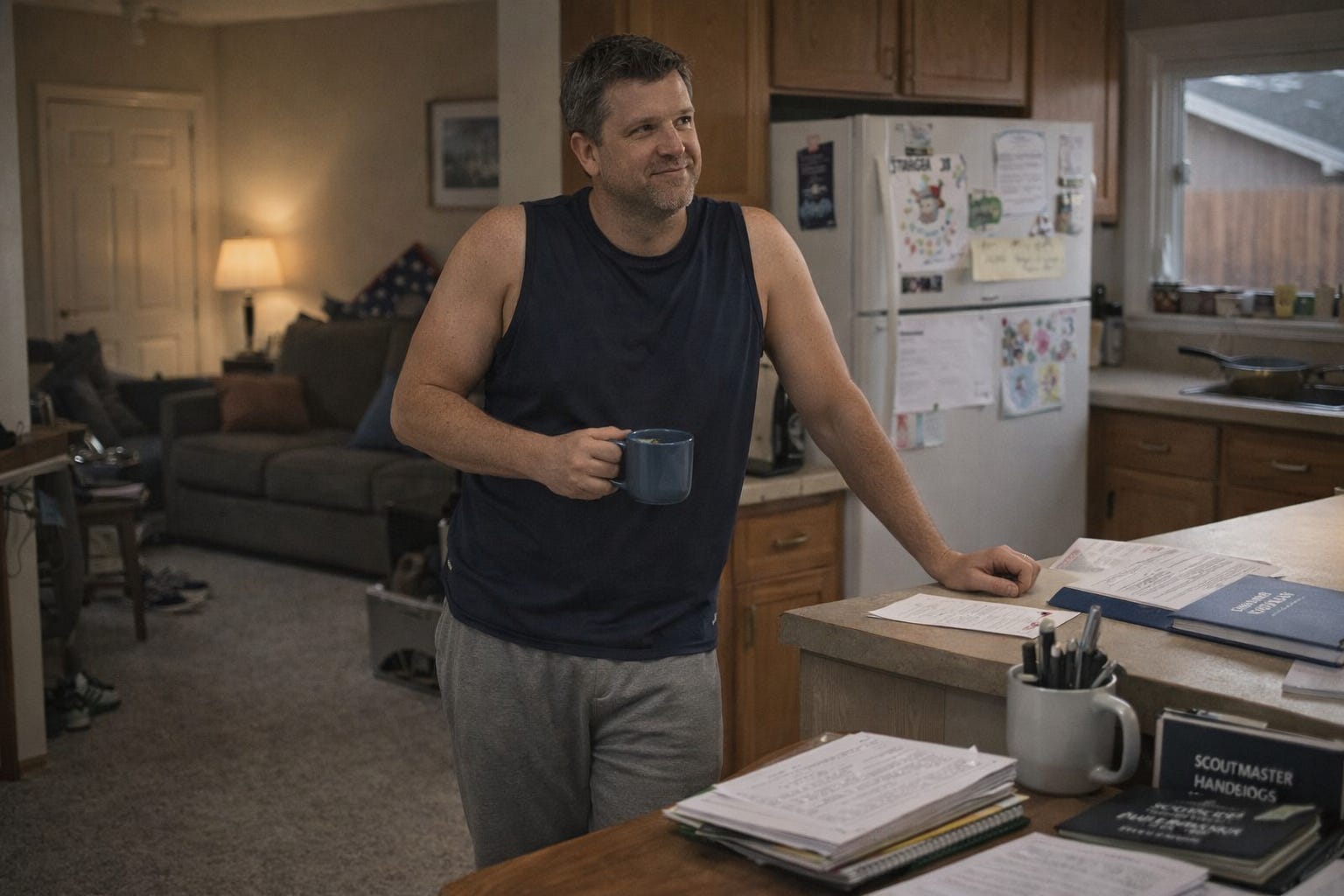
The apartment had two bedrooms, one bathroom, a kitchen with a window that faced the landlord’s backyard, and a living room that functioned, depending on the hour, as a television room, a grading station, a gym, and a tent showroom. The rent was split evenly. The groceries were not, because Danny ate like a man training for something and Corey ate like a man who had opinions about olive oil. They had lived together for three years, since Corey’s divorce, since Lura remarried and moved across town and Corey moved from the house to this apartment with Scott every other week and Emily whenever Emily decided, which was Emily’s prerogative and which Corey did not challenge because challenging Emily was like challenging weather: technically possible, practically futile.
The apartment’s defining feature was the kitchen table. It was a rectangular table of no particular quality, purchased from a secondhand store on Route 11, and it served as the intersection of two lives that had no business intersecting but did. On any given evening the table held: Corey’s student portfolios, his grading rubric, his pen (the good one, the one Danny called “the surgeon”), his Scoutmaster Handbook (dog-eared, tabbed, annotated in the margins), the troop binder Karen had given him nine months ago, a troop calendar he had drawn by hand on poster paper and then redrawn on regular paper when he realized poster paper didn’t fit on the table, and a sketch pad with patrol flag designs that were either in progress or abandoned, it was hard to tell. On Danny’s side: a laptop open to ESPN, a protein shaker with residue, keys, sunglasses, a phone charger that had been there so long it had become furniture.
The table was a map of the apartment. Read it correctly and you knew everything about the two men who lived here.
* * *
Danny Kovacs was thirty-four years old, taught physical education at the high school on Elm Street, coached JV basketball in the winter and intramural baseball in the spring, and approached every day with the energy of someone rested, fed, and pointed at the world like a friendly projectile. He was six-one, broad, with the build of a former athlete who had transitioned from competitive sport to recreational maintenance without losing the frame. He wore gym shorts in the apartment from March through November and sweatpants from December through February, and he considered this a concession to the season that bordered on formal.
He was between girlfriends. This was Danny’s natural state, the way some people are between jobs: not unemployed, exactly, but in a transitional period characterized by optimism and a lack of specifics. His most recent girlfriend, a dental hygienist named Shauna, had ended things in January after determining that Danny was, in her words, “great but not serious,” which Danny had accepted with equanimity—he had heard this assessment before and suspected it was accurate without being troubled by the accuracy. Danny was great. Danny was not serious. These two things coexisted in Danny the way weather coexists with landscape: one moved across the other without changing it.
On a Saturday morning in late February, Danny was making eggs. He made eggs every Saturday, the same eggs: scrambled, with cheese, with hot sauce, with toast that was burned on one side because the toaster had a defective element that Danny had been meaning to fix for two years and that he addressed each Saturday by rotating the bread and accepting the char. The kitchen smelled like butter and hot sauce and coffee, which was the smell of Saturday, which was the smell of Danny.
Corey was at the table. He was not eating. He was working on a campout menu planner, a document he had created using a template from the Scoutmaster Handbook, modified with his own design sensibility, which meant the document was more attractive than any campout menu planner in the history of scouting and also more complicated. The patrol leaders were supposed to fill in their menus for the March campout, and Corey was preparing the form they would use, because Corey prepared forms the way other people prepared meals: with attention, with care, with the conviction that presentation mattered even when the content was hot dogs and canned beans.
“You’re making a spreadsheet for children’s food,” Danny said from the stove.
“It’s not a spreadsheet. It’s a menu planner.”
“It has columns.”
“Columns are a feature of organized documents. They’re not exclusive to spreadsheets.”
“It has columns and rows and boxes where children are going to write ‘hot dogs’ in crayon. That’s a spreadsheet.”
Corey looked up. Danny was standing at the stove in sweatpants and a T-shirt from a 5K he had run four years ago, holding a spatula in one hand and a coffee mug in the other, his hair going in a direction that suggested he had slept on it aggressively. He was grinning. Danny was almost always grinning. His face had a default setting that was two degrees warmer than neutral, a resting expression that communicated goodwill and mild amusement at things that were not yet funny but might become funny if he waited.
“The patrol leaders will fill it in with pencil,” Corey said. “Not crayon.”
“Corey. They’re twelve.”
“They’re learning to plan meals and manage a budget. This is a life skill.”
“It’s a menu for a campout. They’re going to write ‘hot dogs’ in every box and then eat granola bars for every meal. I coached twelve-year-olds for six years. I know what twelve-year-olds eat. They eat whatever is closest and doesn’t require a fork.”
Corey turned back to the menu planner. He added a line for “Estimated Cost Per Meal” and underlined it with the ruler he kept in the binder pocket. Danny watched this from the stove with the expression of a man watching a friend build a cathedral out of popsicle sticks: admiring the effort, questioning the material.
“You know what I love about this,” Danny said, sliding the eggs onto two plates and bringing them to the table, pushing aside the binder and the handbook and the patrol flag sketches to make room. “You used to come home from work and grade papers and drink wine and listen to Sondheim. That was your whole night. Now you come home from work and grade papers and drink wine and listen to Sondheim and design campout forms and sketch patrol flags and read the handbook and take notes on the handbook and then take notes on your notes. You added an entire second career to your evenings and you didn’t drop anything from the first one. You just stopped sleeping.”
Corey took the plate. “I sleep.”
“You sleep like a man who has two jobs and a pen that costs more than my car payment.”
They ate. The eggs were good, the way Danny’s eggs were always good, not because Danny was a skilled cook but because Danny was a confident one, and confidence in cooking, like confidence in teaching, covered a multitude of technical deficiencies. The toast was burned on one side. Corey ate it without comment because he had been eating Danny’s burned toast for three years and the burned toast was part of Saturday the way the eggs were part of Saturday and the hot sauce was part of Saturday, and Corey, who had opinions about food that Danny found decorative, had never once suggested fixing the toaster, because fixing the toaster would have changed Saturday, and Saturday didn’t need changing.
* * *
Emily arrived at eleven. She did not knock, because Emily did not knock at her father’s apartment, because Emily was fifteen and the apartment was, in her understanding, an extension of her own territory, a satellite office of her life that she visited when the mood or the custody schedule required. She walked in carrying a backpack and wearing an expression that communicated tolerance for the world and its arrangements.
“Hey, Dad. Hey, Danny.”
“Hey, kid,” Danny said from the couch, where he had migrated after breakfast to his natural habitat: horizontal, ESPN on, phone in hand.
Corey stood from the table and hugged her, which Emily permitted with the benign patience of a teenager accepting a parental gesture she found unnecessary but not worth resisting. She was taller than she had been at Christmas. She was taller than she had been two weeks ago, or Corey was imagining it, which was possible, because parents imagine growth in their children the way gardeners imagine growth in their plants: constantly, hopefully, with a measuring instrument that is mostly emotional.
“How’s your mom?”
“Fine. She says hi. She also says you need to sign the permission slip for Scott’s field trip because she can’t find it and he says you have it.”
“It’s in his backpack. Front pocket.”
“I’ll tell her.” Emily dropped her backpack by the door and surveyed the apartment with the evaluative gaze of a person inspecting a property she did not own but had opinions about. Her eyes moved across the living room (Danny’s sneakers, Danny’s hoodie on the back of the couch, Danny’s protein shaker on the coffee table) and then to the kitchen table (the binder, the handbook, the menu planner, the patrol flag sketches, the pen).
“You’re still doing the Scout thing,” she said.
“I’m still doing the Scout thing.”
“Scott says you’re obsessed.”
“Scott says a lot of things.”
“He says you practice tying knots at the kitchen table and you still can’t do the one that starts with B.”
“The bowline.”
“That one. He says you tried it forty times and Danny had to look up a YouTube video.”
Danny, from the couch: “The YouTube video didn’t help either.”
Emily sat down at the table across from Corey, in the chair that was Danny’s chair at meals but was Emily’s chair when Emily was here, because the apartment reconfigured itself around Emily’s presence the way a room reconfigures itself around a window being opened. She picked up a patrol flag sketch and looked at it.
“This is actually good,” she said, with surprise, revising her low expectations. “Did you design this?”
“I did.”
“The hawk looks real. Not like a cartoon hawk. Like a real one.”
“Thank you.”
“You should be doing this instead of teaching.” She set the sketch down. “Designing things. You’re good at it.”
Corey looked at his daughter, who had just paid him the kind of compliment that fifteen-year-olds pay rarely and without warning, the way a slot machine pays out: randomly, generously, and in a way that makes you want to keep playing even though the odds are terrible. He did not say anything sentimental, because saying something sentimental to Emily was like throwing a ball at a cat: it would be observed, possibly judged, and certainly not returned.
“How’s school?” he asked.
“Fine.”
“Anything new?”
Emily shrugged. The shrug was a fifteen-year-old’s shrug, which is an entire language compressed into a single gesture, a language that can mean anything from “nothing is new” to “everything is new and I will tell you none of it.”
“I’m seeing someone,” she said.
Corey’s hand, which was holding the pen, stopped. The pen hovered over the menu planner. The air in the kitchen performed a slight reorganization.
“Seeing someone,” Corey repeated.
“It’s not a big deal. We’ve been hanging out for a couple weeks. He’s nice. He goes to my school.”
“What’s his name?”
“Nicholas.”
Corey heard the name. He filed it the way he filed all information about Emily’s social life: carefully, without visible reaction, in the part of his brain that wanted to ask thirty-seven follow-up questions and the part of his brain that knew asking thirty-seven follow-up questions would result in Emily never telling him anything again. Nicholas. A name. A boy. His daughter was seeing a boy named Nicholas who went to her school and was nice and with whom she had been hanging out for a couple weeks. This was normal. This was the normal progression of a fifteen-year-old’s life. This did not require thirty-seven follow-up questions.
“That’s great,” Corey said.
Emily looked at him with the expression of a person evaluating whether a response was genuine or performed. She determined it was genuine, or close enough, and nodded.
“He’s kind of quiet,” she said. “Polite. His dad’s a cop.”
Corey heard this too. His dad’s a cop. He heard it and it settled somewhere in the back of his mind, in the place where facts wait for connections that haven’t arrived yet. There were cops in the town. There were many cops in the town. Nick Testa was a cop in the town, but Nick Testa was one cop among many, and “his dad’s a cop” was not a thread that led anywhere specific, not yet, not in a town with a police force of forty-three officers, and Corey’s mind, which was occupied with menu planners and patrol flags and the March campout and whether the boys would actually write “hot dogs” in every box, did not follow the thread. He let it lie there, a fact without a frame, and moved on.
Danny, from the couch, not looking up from his phone: “A cop’s kid. That’s either going to be the best-behaved boyfriend you’ve ever met or the most rebellious. No middle ground.”
Emily looked at Danny. “He’s the well-behaved kind.”
“Good,” Danny said. “The other kind borrows your car.”
Emily stayed for two hours. She sat on the couch with Danny and watched a basketball game she didn’t care about and made observations about the players’ hair that Danny found hilarious and Corey found baffling. She ate a sandwich. She looked at her phone. She told Corey about a teacher she liked and a teacher she didn’t and a project she was working on about the Harlem Renaissance that she was actually interested in, which she communicated by talking about it for more than two sentences, which was Emily’s way of indicating enthusiasm. She did not mention Nicholas again. The name had been introduced, placed on the table like the patrol flag sketch, and left there for anyone who wanted to pick it up. Corey did not pick it up, because picking it up would mean asking questions, and Emily had given him what she was going to give him, and the rest would arrive on Emily’s schedule, which was not his to set.
She left at one. She hugged Corey at the door, quickly, the way she had permitted the earlier hug, except this time she initiated it, which was different, and Corey held it for one second longer than she intended and she let him.
“Bye, Danny.”
“Later, kid.”
The door closed. The apartment returned to its two-person configuration. Danny looked at Corey from the couch.
“Nicholas,” Danny said.
“Yep.”
“Cop’s kid.”
“Yep.”
“You okay?”
“She’s fifteen.”
“That wasn’t what I asked.”
Corey sat back down at the table. He picked up the pen. He looked at the menu planner, which now seemed like the most trivial document in the world, a piece of paper about hot dogs while his daughter was seeing a boy whose name he had just learned and whose face he had never seen and who existed, as of this moment, only as a name and a father’s occupation and the word “nice,” which was the least informative adjective in the English language and the one teenagers used when they meant anything from “adequate” to “I am in love.”
“I’m fine,” Corey said.
“You’re holding the pen like you’re going to stab someone with it.”
Corey looked at his hand. He was, in fact, gripping the pen with more force than a menu planner required. He set it down.
“She’s growing up,” Danny said. “That’s what they do. She came in, she told you about him voluntarily, she didn’t hide it. That’s a good sign. That means she trusts you.”
“I know.”
“So be the dad she trusts. Don’t be the dad who makes her wish she hadn’t said anything.”
Corey looked at Danny. Danny was still on the couch, still in sweatpants, still holding his phone, still occupying the same square footage he had occupied all morning. He had not moved. He had not changed position. He had simply been present, the way Danny was always present, and from that position of absolute stillness he had said the most useful thing anyone would say to Corey all week.
* * *
The Court of Honor was on a Thursday evening, two weeks later, in the church basement. It was a small ceremony, three rank advancements and two merit badges, the kind of Court of Honor that happened quarterly and that Karen organized with the thoroughness of a woman planning a state dinner for an audience of forty.
Danny came because Scott had asked him to.
This was the detail that mattered, not that Danny came to a Scout ceremony, but that Scott had asked. Scott, who was quiet and anxious and positioned himself at the edges of groups, had walked up to Danny on a Tuesday evening and said, “Are you coming to the Court of Honor on Thursday?” And Danny, who had never attended a Scout event and who had no reason to attend a Scout event and who would have preferred to spend Thursday evening on the couch with a basketball game and a beer, said, “Yeah, buddy, I’ll be there.” He said it without hesitation. He said it the way you say things to children when the asking is the important part, when a child has worked up the courage to want something and the only correct response is yes.
Danny arrived at the church in jeans and a button-down shirt, which was Danny’s version of dressing up and which, on Danny, looked like a man who had been informed thirty minutes ago that jeans and a T-shirt were not appropriate and had made the minimum required adjustment. He walked into the basement and stood in the doorway and looked at the room: the flag, the knot board, the folding chairs arranged in rows, the table at the front with the awards and certificates laid out in Karen’s precise arrangement, the troop banner, the parents sitting in the chairs, the boys in uniform along the side wall.
“This is very official,” Danny said to Corey, who was standing at the front of the room in his uniform, preparing to begin.
“It’s a ceremony.”
“There’s a banner. There are name cards on the awards. Karen’s wearing a blazer.”
“Karen always wears a blazer to Courts of Honor.”
“Of course she does.” Danny looked around the room again. “Where do I sit?”
“Anywhere. You’re a guest.”
Danny sat in the back row. He sat the way Danny sat everywhere: fully, taking up the chair and the space around the chair with the casual territorial expansion of a man who was large and did not think about being large. The parents in the adjacent seats adjusted. Danny smiled at them. The smile was Danny’s all-purpose social instrument, warm and automatic, the smile of a man who assumed he was welcome and was usually right.
Corey opened the ceremony. He had written notes but did not use them, because Corey had learned, nine months into this job, that speaking from notes was less effective than speaking from attention, and Corey’s attention was the thing he did best. He welcomed the families. He described what the boys had accomplished. He spoke about each scout individually, by name, with specific details: Parker’s first aid work, Diego’s campout attendance, Avery’s growth as a patrol leader. He spoke the way he spoke in his classroom, with quiet authority, returning the attention the room had paid him.
Karen stood to the side with her clipboard. She was, as Danny had noted, wearing a blazer. It was navy, serious, the blazer of a woman who believed that ceremonies deserved formality even when the ceremony was in a church basement and the audience was twelve families and a roommate in jeans. She watched Corey speak and her face did something it had been doing more frequently since the Board of Review: a careful neutrality that was not the same as her previous careful neutrality, which had been the neutrality of assessment. This was the look of someone who was watching something work and was not sure how she felt about it working.
The awards were presented. Parker received his Tenderfoot badge and grinned the grin. Diego received his Scout rank and shook Corey’s hand with the formality his mother had taught him. Maria was in the audience, sitting in the front row in a coat she hadn’t taken off because the basement was cold, and when Diego’s name was called she pressed her hands together and held them against her mouth, and the gesture was so small and so full that Corey had to look away for a moment because the looking was too much.
Avery received his Second Class rank and said “Thank you, Mr. Whitman” in the careful voice of a boy who was taking this seriously for the first time, who was beginning to understand that the rank was not just a patch but a marker, a thing that said you had been somewhere and done something and someone had noticed.
Danny clapped. Danny clapped the way Danny did everything: enthusiastically, without reservation, louder than anyone else in the room. The other parents clapped politely, the controlled applause of people in a church basement at eight o’clock on a Thursday. Danny clapped the way a man claps at a baseball game when his team scores, full-handed, committed, the clap of a person who did not modulate his responses to match the room because it had never occurred to him that responses should be modulated.
Scott, standing with the other boys along the wall, looked at Danny in the back row and smiled. It was a small smile, the smile of a quiet boy who had asked someone to come and the someone had come, and the someone was clapping louder than anyone, and the loudness was not embarrassing, not tonight, because tonight the loudness meant something that Scott could feel without naming, which was that he was seen, that the people who mattered to him were in the room, and that one of them was clapping like it was the World Series.
* * *
After the ceremony there were refreshments. There were always refreshments. Karen organized the refreshments the way she organized everything, which meant there was a table with a cloth and napkins and cookies arranged on a plate and juice boxes for the boys and coffee for the adults, and the arrangement was precise enough that it looked catered even though it had been assembled by one woman with a Costco membership and an unwillingness to delegate.
Danny was at the refreshment table. He was eating cookies. He was eating cookies with focused contentment, having discovered an unexpected food source and intending to exploit it fully. Karen approached the table to straighten the napkins and found Danny standing there with three cookies in one hand and a juice box in the other.
“The cookies are for the scouts,” Karen said.
“I’m a guest. Guests get cookies.”
“Guests get coffee.”
Danny looked at the juice box in his hand. He looked at Karen. “I like juice boxes.”
Karen looked at Danny. Danny looked at Karen. The moment held. It was the first time they had spoken since the gear store several months ago, and in the gear store Karen had seen Danny and Corey shopping together and had filed the observation under a heading she had been building for months. Now she was seeing Danny again, at a troop event, standing at the refreshment table in a button-down shirt and jeans, eating cookies intended for children and drinking a juice box, and she was performing the same calculation she always performed, the assessment, the categorization, the placement of information into the framework she had built for understanding Corey Whitman and the people in his life.
Danny did not know he was being assessed. Danny moved through the world with the uncomplicated assumption that people took him at face value, because most people did, and because Danny’s face value was friendly and uncomplicated and required no further analysis. He did not know that Karen saw his presence at the ceremony as evidence. He did not know that Karen saw his relationship with Corey as a data point. He did not know that Karen had a file.
“You’re Corey’s roommate,” Karen said.
“Danny. Yeah. We met at the camping store.”
“I remember.”
She remembered everything. She remembered the gear store and the fleece and the coloring question and the way Danny and Corey had moved through the aisles together, the easy intimacy of two people who shared a household and a grocery list and an understanding of each other’s preferences. She remembered thinking what she had thought, and she had not revised the thinking, because Karen did not revise easily, and the information that would require revision had not yet arrived.
“Scott asked me to come,” Danny said. “Good kid. Quiet, but he’s coming out of his shell. I think the troop’s been really good for him.”
Karen’s expression shifted. It was a small shift, barely detectable, but it was there: a flicker of interest that was not about Danny’s relationship to Corey but about Danny’s observation of Scott. Karen cared about the boys. However complicated her feelings about the adults, the boys were the reason she had stayed for twelve years, and a person who noticed that a boy was coming out of his shell was a person who was paying attention, and Karen respected attention.
“He’s improved,” Karen said. “His confidence is building. His patrol leader says he’s reliable.”
“That sounds like Scott. He’s not the kid who’s going to lead the charge. He’s the kid who’s going to make sure the supplies are packed.”
Karen nodded. The nod was acknowledgment, not warmth, but acknowledgment from Karen was its own currency, and Danny had just received a small denomination without knowing he’d earned it.
“Nice meeting you again,” Danny said, and he took another cookie and walked away, leaving Karen at the refreshment table with her napkins and her clipboard and her file, which had just received a new entry that she would process later, at home, the way she processed everything: alone, systematically, without conclusion.
* * *
Corey and Danny and Scott drove home together. Scott was in the back seat, holding his merit badge card, looking at it the way a boy looks at something he has earned, with the quiet pride of a person who is not yet old enough to be modest about achievement and not yet old enough to pretend that achievement doesn’t matter.
“That was nice,” Danny said. “The ceremony. The whole thing. Karen’s intense but she puts on a good show.”
“She’s been doing it for twelve years.”
“It shows.” Danny paused. “She asked me about you, kind of. Not directly. She asked about ‘your household,’ which is a weird thing to ask a roommate you’ve met once.”
Corey glanced at him. “What did you say?”
“I said we live together and split the rent and you hog the kitchen table with Scout stuff. Why? What’s the subtext I’m missing?”
Corey was quiet. He drove. The streets were dark, the February dark that settles over small towns in upstate New York like a lid, a darkness that is not unkind but is absolute, the kind of darkness you learn to live inside.
“I don’t think there’s subtext,” Corey said, because Corey did not think there was subtext, because Corey did not know about the file, did not know about the spreadsheet with the sixteen categories, did not know that Karen McKay had been watching him for nine months with a theory that organized every observation and that the theory was wrong in its premise and persistent in its application. He did not know that Danny’s presence at the ceremony had been cataloged. He did not know that the word “roommate” had been placed in quotation marks in Karen’s mind, the way a word is placed in quotation marks when the person writing it does not believe the word means what it says.
“She’s just thorough,” Corey said.
“She’s something,” Danny said.
From the back seat, Scott said, “Danny, you clapped really loud.”
“Is that bad?”
“No,” Scott said. “It was good.”
Danny reached back and tousled Scott’s hair without looking, an easy gesture that years had made automatic, and Scott let him, the way he let Danny do things he would not have let other adults do, because Danny occupied a category in Scott’s life that did not have a name. He was not a father. He was not an uncle. He was not a stepfather. He was the man on the couch who made burned toast on Saturday mornings and came to the Court of Honor when Scott asked and clapped louder than anyone, and there is no word for what that is, but the thing it is doesn’t need a word. It just needs to keep showing up.
They got home. Scott went to bed. Danny went to the couch. Corey went to the kitchen table, where the menu planner was waiting, and the binder, and the handbook, and the pen, and the patrol flag sketches, and all the evidence of a life that had expanded to include something it hadn’t planned for.
He picked up the pen. He pulled the menu planner toward him. He wrote, in the header, in his careful handwriting: MARCH CAMPOUT, HAWK PATROL. He looked at the columns and the rows and the boxes where the boys would write their meals, and he thought about Danny at the stove saying “They’re going to write hot dogs in every box,” and he smiled, because Danny was probably right, and the toast would be burned on one side, and the apartment would smell like Saturday, and all of it was exactly right.