

Outfitting
From the "Troop 13" Series

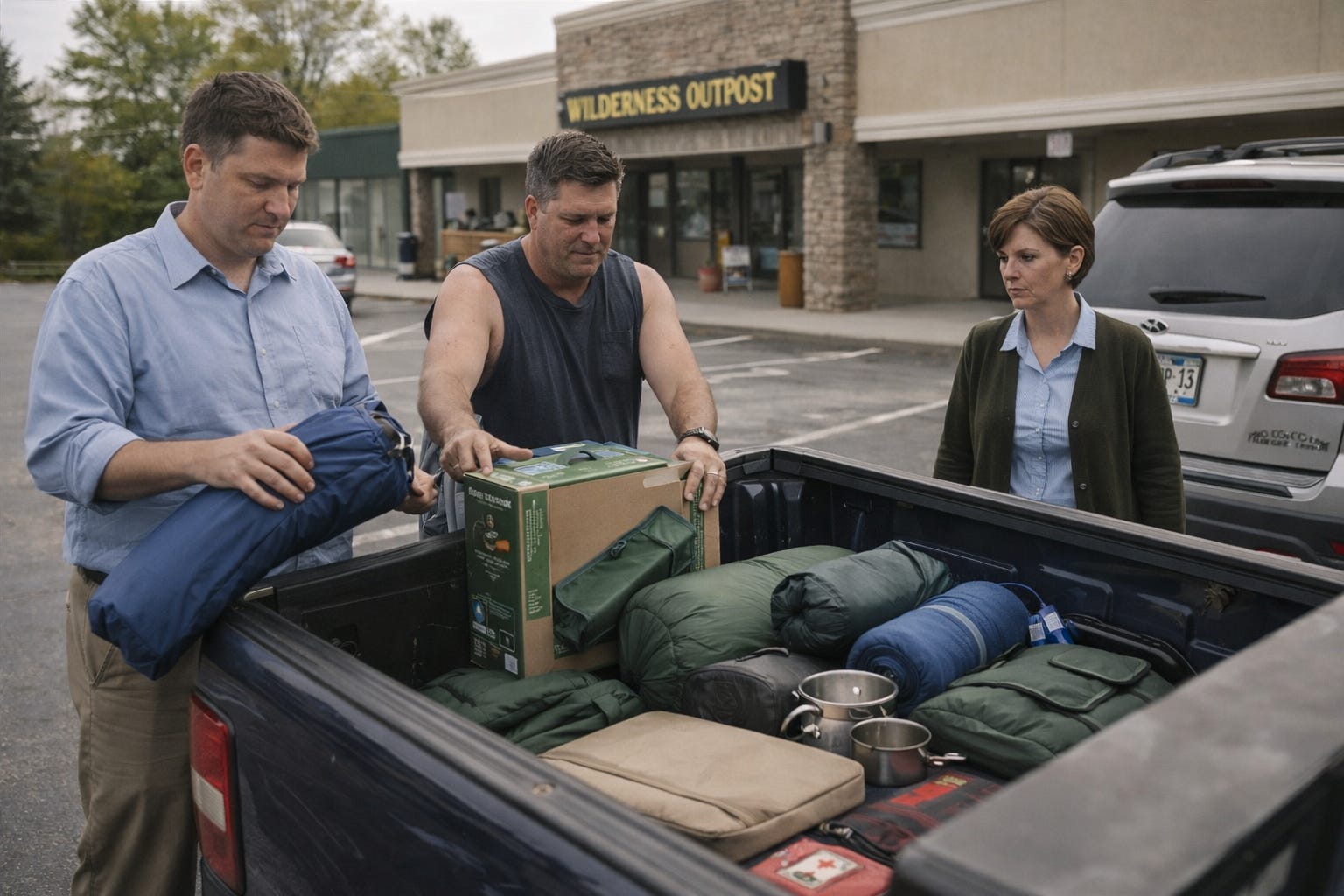
The first campout was in three weeks and Corey owned nothing. He had the binder. He had a felt-tip pen. He had enthusiasm, which Danny said was the most dangerous thing a person could bring into the woods.
“You need a tent,” Danny said. They were in his truck, a Ford F-150 that smelled like gym bags and drive-through coffee, heading toward the outdoor store on Route 9. Danny had volunteered to come because Danny had been camping before, or at least his version of camping, which involved a buddy’s cabin in the Adirondacks, a cooler of beer, and a weekend of fishing in which no fish were caught but several were discussed at length. Still, he owned boots. He knew what a ground pad was. In the country of the blind, the man with one fishing trip is king.
“I know I need a tent,” Corey said. He had made a list. The list was written on a legal pad in his careful handwriting, drawn from the equipment checklist in the scoutmaster binder under the blue tab. He had underlined the items he understood and starred the items he didn’t, and there were more stars than underlines.
“You need a sleeping bag rated for the temperature you’re going to be sleeping in, not the temperature you wish you were sleeping in.”
“What does that mean?”
“It means you’re going to pick the one that feels nice in the store, and I’m telling you right now, the one that feels nice in the store is the one that’s going to feel like a bedsheet when it’s forty-two degrees at three in the morning.”
“Is it going to be forty-two degrees?”
“It’s April in New York. It could be seventy. It could be thirty-five. That’s the game.”
Corey looked at his list. He had circled the word LAYERING because the binder had a section on layering that he’d read twice and found theoretically sound but practically meaningless, the way a person who has never been cold finds discussions of cold interesting but abstract.
* * *
The store was called Wilderness Outpost, which was a generous name for a building that shared a parking lot with a pet groomer and a place that sold discount tires. It was the kind of outdoor store that existed in every town within driving distance of state land: large enough to have departments, small enough that the guy who sold you a tent was the same guy who rang you up at the register. The interior smelled like rubber and nylon and the particular mustiness of things that were meant to be used outdoors but had spent their lives on metal shelving under fluorescent lights.
Danny moved through the store with purposeful ease, knowing what he was looking at. He went directly to the sleeping bag aisle and began squeezing things, which was apparently how you evaluated a sleeping bag. He squeezed the fill. He checked the temperature ratings. He unzipped one and put his arm inside and made a face that indicated either approval or the memory of his fishing trip. Corey stood next to him holding his legal pad and trying to follow.
“This one,” Danny said, pulling a bag off the shelf. It was dark green and compressed into a stuff sack the size of a cantaloupe. The tag said it was rated to twenty degrees. “You want synthetic fill, not down. Down is better until it gets wet, and then it’s a garbage bag. You’re going to get wet.”
“Why am I going to get wet?”
“Because you’re going camping.”
Corey looked at the green bag and then at the bag next to it, which was a deep navy blue with a charcoal interior and a zipper pull that had been designed by someone who understood that functional objects could also be attractive. The navy bag was rated to forty-five degrees. It was also sixty dollars cheaper.
“What about this one?” Corey said.
Danny looked at the tag. “Forty-five degree rating.”
“You said it could be seventy.”
“I also said it could be thirty-five.”
“But it’s more likely to be in the forties.”
“Corey. Why are you looking at that bag.”
“It’s a good bag.”
“You like the color.”
“The color is a factor.”
“The color is not a factor. The color is never a factor. You are going to be inside this bag in the dark. Nobody is going to see the color. You are going to see the inside of your eyelids and you are going to feel either warm or cold, and if you buy that bag you are going to feel cold.”
Corey put the navy bag back on the shelf. He picked up the green bag. It was not a beautiful object. It was the color of something the army would issue. But Danny was right, and Corey knew Danny was right, in the same way he knew that the camp chair should be purchased for durability rather than aesthetics and that the headlamp should be chosen for lumens rather than design. He knew these things intellectually. The problem was that his hands kept reaching for the beautiful thing.
They moved through the store this way, aisle by aisle, in a pattern that repeated with small variations. Corey would be drawn to the object that looked best. Danny would steer him toward the object that worked best. They would have a brief negotiation in which function and form argued their cases, and function would win, except in the instances where Corey made his selection while Danny was in the restroom or looking at something else, which accounted for the camp chair (slate blue, low-profile, elegant, structurally questionable) and the mess kit (brushed stainless steel with a leather grip, the kind of thing a nineteenth-century explorer would carry, rated for a lifetime of use and weighing approximately as much as a small dog).
* * *
The tent was the main event. Corey needed a tent that he could set up alone, that would sleep one adult comfortably, and that he could carry from a parking area to a campsite without requiring a second trip. Danny explained these requirements. Corey heard them. What Corey saw, when they arrived at the tent aisle, was a wall of color and geometry, domes and tunnels and A-frames in orange and green and gray and a blue so deep it looked like it had been mixed on a palette.
“Ignore how they look,” Danny said, which was like telling Corey to ignore the weather.
A salesman appeared. He was in his early twenties, bearded, wearing a fleece vest with the store logo embroidered on the chest. He had the lean, tanned look of someone who actually used the products he sold, which distinguished him from most retail employees and made him, in Corey’s estimation, a credible source.
“First tent?” the salesman asked.
“First everything,” Corey said.
The salesman walked them through the options. He talked about denier counts and pole materials and vestibule space with practiced ease, having given this tour before. Danny asked good questions. Corey asked questions that revealed him. He asked about the interior color of one tent (“Does it come in anything other than orange? Orange light would be oppressive”). He asked whether the rain fly on another tent could be removed entirely on clear nights (“for the aesthetic”). He asked about a tent that was displayed on an upper shelf, a sleek, low-profile design in charcoal and slate that looked like something an architect would take into the wilderness.
“That’s a mountaineering tent,” the salesman said. “Ultralight. Four-season. About eight hundred dollars.”
“It’s beautiful,” Corey said.
“It’s for Everest,” Danny said. “You’re going to a field behind a church.”
They settled on a three-season dome in forest green that was neither the cheapest option nor the most expensive, that had a setup the salesman described as “pretty intuitive” (a phrase Corey would remember with bitterness three weeks later in the dark), and that Danny approved of after inspecting the pole clips and the floor seams and the zipper tracks with the thoroughness of a man buying a used car.
Corey stood at the register with a cart that contained the tent, the green sleeping bag, the questionable camp chair, the overweight mess kit, a headlamp, a ground pad that Danny had selected without consultation, a first aid kit, two packages of fire starters, and a rain jacket that was the one item on which both men agreed: it was functional, well-made, and happened to be a shade of blue that Corey found acceptable. The total was four hundred and sixty-two dollars. Corey paid it like someone signing a check and trusting the amount would make sense later.
* * *
They were loading the truck when Karen McKay pulled into the parking lot.
She drove a silver Honda CR-V with a Troop 13 bumper sticker on the rear window and a license plate frame that said BOY SCOUTS OF AMERICA. The car was clean in the way that a car is clean when its owner considers a dirty car to be a moral statement. She parked three spaces from Danny’s truck, got out, and walked toward the store entrance with the stride of a woman who was here for a specific item and intended to acquire it and leave.
She saw Corey before Corey saw her. He was standing at the tailgate of Danny’s truck holding the camp chair, which was still in its carrying bag, examining it the way a person examines a purchase they’re not yet sure about. Danny was beside him, rearranging the bed of the truck to make room for the tent box, his sleeveless arms and gym-teacher build on full display. They were talking. Danny said something and Corey laughed, and Karen McKay stood in the parking lot and watched two men loading camping gear into a pickup truck and saw exactly what she expected to see.
“Corey,” she said, crossing toward them.
He turned. “Karen. Hi.”
Her eyes moved from Corey to Danny to the truck bed full of new gear. She took inventory the way she took inventory of everything, quickly and completely. “Shopping for the campout?”
“Getting equipped. Karen, this is Danny. My roommate. Danny, this is Karen McKay, the committee chair.”
Danny wiped his hand on his shorts and extended it. “How’s it going?”
Karen shook his hand. “Pleasure,” she said, and the word was perfectly polite and perfectly contained, a word that acknowledged Danny’s existence without committing to an opinion about it. Her eyes stayed on him a beat longer than conversational necessity required. She was reading him. His tank top. His build. His easy proximity to Corey. The shared truck. She was reading all of it and filing it in the place where Karen filed things she didn’t say out loud.
“What did you get?” she asked Corey, turning to the truck bed.
Corey showed her. The tent, the sleeping bag, the rain jacket. Karen nodded at each item with the appraising attention of a woman who had opinions about camping gear the way some people have opinions about wine. She picked up the sleeping bag stuff sack and checked the tag.
“Twenty degrees,” she said. “That’s good. A lot of new leaders buy a forty-degree bag and regret it.”
“He almost did,” Danny said. “It was blue.”
Karen looked at Danny. Danny grinned at her. Karen did not grin back, but she processed the comment and its implications, which were that Danny had prevented Corey from making a poor decision based on color, which meant Danny knew something about camping, which meant Danny and Corey went camping together, which meant something to Karen that it did not mean to Danny or to Corey or to anyone else in the parking lot.
She picked up the camp chair bag. She didn’t open it. She just held it, testing the weight, and her face performed a microexpression that Corey would not have noticed if he were not a man who spent his professional life studying faces. The expression said, without words: this is not a serious camp chair.
“How’s your first aid kit?” she asked, setting the chair down.
“I bought one inside.”
“The store kits are a start. I’d supplement it. Moleskin, antihistamines, a good pair of tweezers. The boys always have splinters.” She was already shifting into operational mode, the mode where Karen was most herself and most useful. “Do you have a whistle?”
“Should I have a whistle?”
“Every scout and every leader should have a whistle on their person at all times in the field. It’s in the guide.”
Corey didn’t know which guide she meant. There were several. The binder alone contained references to four different publications, and he had purchased two of them from the Scout shop and read neither completely. He was getting the sense, standing in a parking lot with a truck full of new gear and a woman who knew the page number of the whistle requirement, that the gap between where he was and where he needed to be was larger than he’d estimated.
“I’ll get a whistle,” he said.
“Get two. You’ll lose one.”
Karen looked at the truck one more time. She was deciding something about what she saw, about the two men and the new gear and the camp chair that weighed too little and the mess kit that weighed too much, and whatever she decided, she kept it in the place where she kept everything, behind the posture and the clipboard and the twelve years of running a troop committee that she believed was functioning properly because the paperwork was current and the charter was filed and the boys had uniforms and the meetings happened on Tuesdays, even if what happened inside those meetings, and what happened in the field under Stash Stapanski’s leadership, was something she had never examined too closely. The troop was hers. She maintained it. That was enough, and it had been enough, until three weeks ago when the scoutmaster was arrested in a parking lot and the whole apparatus revealed itself to be held together with habit and the loosest possible definition of competence.
But Karen did not think about it that way. Karen thought the troop was fine, imperfect but functional, because she measured it by the metrics she controlled: the charter, the calendar, the advancement records, the committee meetings she ran with color-coded agendas. She did not measure it by what happened in the woods, because she did not go into the woods. She didn’t know that Stash cooked the food on campouts himself while the boys sat at the picnic table and waited to be served, or that he canceled trips when the forecast showed rain, or the possibility of rain, or clouds that he felt looked suspicious. She knew the troop camped out most months, because Stash told her they did, and Karen took people at their word when their word confirmed what she already believed.
None of this was visible in a parking lot on a Saturday afternoon. What was visible was a woman who knew about whistles and sleeping bag ratings and the importance of moleskin, standing next to a man who had bought a camp chair for its color and a mess kit for its aesthetics, and the other man, the roommate, the loud one in the tank top who knew about sleeping bags and drove the truck and called Corey by his first name with the ease of long familiarity.
“I should get inside,” Karen said. “I need a replacement mantles for my lantern. The troop lantern,” she corrected, because Karen distinguished between her possessions and the troop’s possessions, even when the troop’s possessions lived in her garage.
“Good running into you,” Corey said.
“Register for the training,” she said. “Green tab.”
She walked toward the store entrance without looking back. Danny watched her go.
“So that’s Karen,” he said.
“That’s Karen.”
“She looked at me like she was trying to figure out my tax bracket.”
“She looks at everyone that way.”
“No,” Danny said, closing the tailgate. “She looked at me specifically. Like she was filing me.”
Corey considered this and dismissed it, because Corey did not see what Danny saw. He did not see what Karen saw. He saw a committee chair who cared about her troop and wanted her new scoutmaster to buy a whistle. The rest of it, the reading, the filing, the assessment that was happening every time Karen McKay looked at him and the people around him, was invisible to Corey Whitman in the way that water is invisible to a fish. He was swimming in it. He just didn’t know it.
* * *
Danny drove. The truck bed rattled with new gear and the cab smelled like the nylon and rubber of the tent box. They were quiet for a few minutes, which was unusual for Danny, who generally filled silence the way nature fills a vacuum, automatically and completely.
“Can I ask you something?” Danny said.
“Sure.”
“Do you know what you’re doing?”
“No.”
“Okay. Just checking.”
They drove in silence for another mile. The town passed by outside the windows, the same streets Corey drove every day, but they looked different from the passenger seat of Danny’s truck with four hundred dollars of camping equipment behind him and a commitment he couldn’t undo sitting in a binder on his kitchen table. He thought about Karen in the parking lot, the way she’d picked up the sleeping bag and checked the rating as if it were a test he might have failed. The way she’d held the camp chair and not said what her face was saying. The way she’d said “green tab” as if the tabs in the binder were common knowledge, as if everyone organized their lives in labeled sections and the only question was whether you’d read the right one.
“She told me to buy a whistle,” Corey said.
“You should buy a whistle.”
“She said to buy two because I’d lose one.”
Danny glanced at him. “You will lose one.”
“How do you know that?”
“Because you lose everything small. You’ve lost three pairs of reading glasses since I moved in. You lost your keys at the grocery store last month. You left your phone in the faculty lounge twice in one week.”
“The phone was a coincidence.”
“Buy two whistles, Corey.”
They pulled into the apartment parking lot. Danny killed the engine and they sat for a moment, looking at the building, the converted house with the peeling paint on the second-floor railing and the landlord’s garden gnome collection on the front lawn that no tenant had ever had the courage to mention.
“You’re going to figure this out,” Danny said. He said it the way Danny said things, without preamble or sentimentality, just a flat statement delivered while looking straight ahead through the windshield. “You figured out teaching. You figured out the divorce. You’ll figure out camping. You just have to stop buying things based on how they look.”
“I appreciate the confidence.”
“I’m being serious.”
“I know you are. That’s why I appreciate it.”
They unloaded the gear and carried it upstairs. Corey set the tent box on the living room floor and stood over it, reading the instructions on the side of the box, which included a diagram that looked simple in the way that things look simple before you attempt them. Danny went to the kitchen and opened a beer and came back and stood in the doorway and watched Corey read the box.
“You’re going to practice setting it up in here, aren’t you,” Danny said.
“I’m going to practice setting it up in here.”
“In the living room.”
“Where else would I practice?”
Danny took a long pull of his beer. “I’m going to need to move the coffee table.”
“You’re going to need to move the coffee table.”
Danny nodded. He took another sip. He looked at Corey, who was already opening the box with the careful precision of a man who intended to read every word of the instructions before touching a single pole, and something crossed Danny’s face that was not quite a smile and not quite concern.
He set his beer on the counter. He walked into the living room. He moved the coffee table.
Oh no Karen! Does this mean...🫢