

The Board

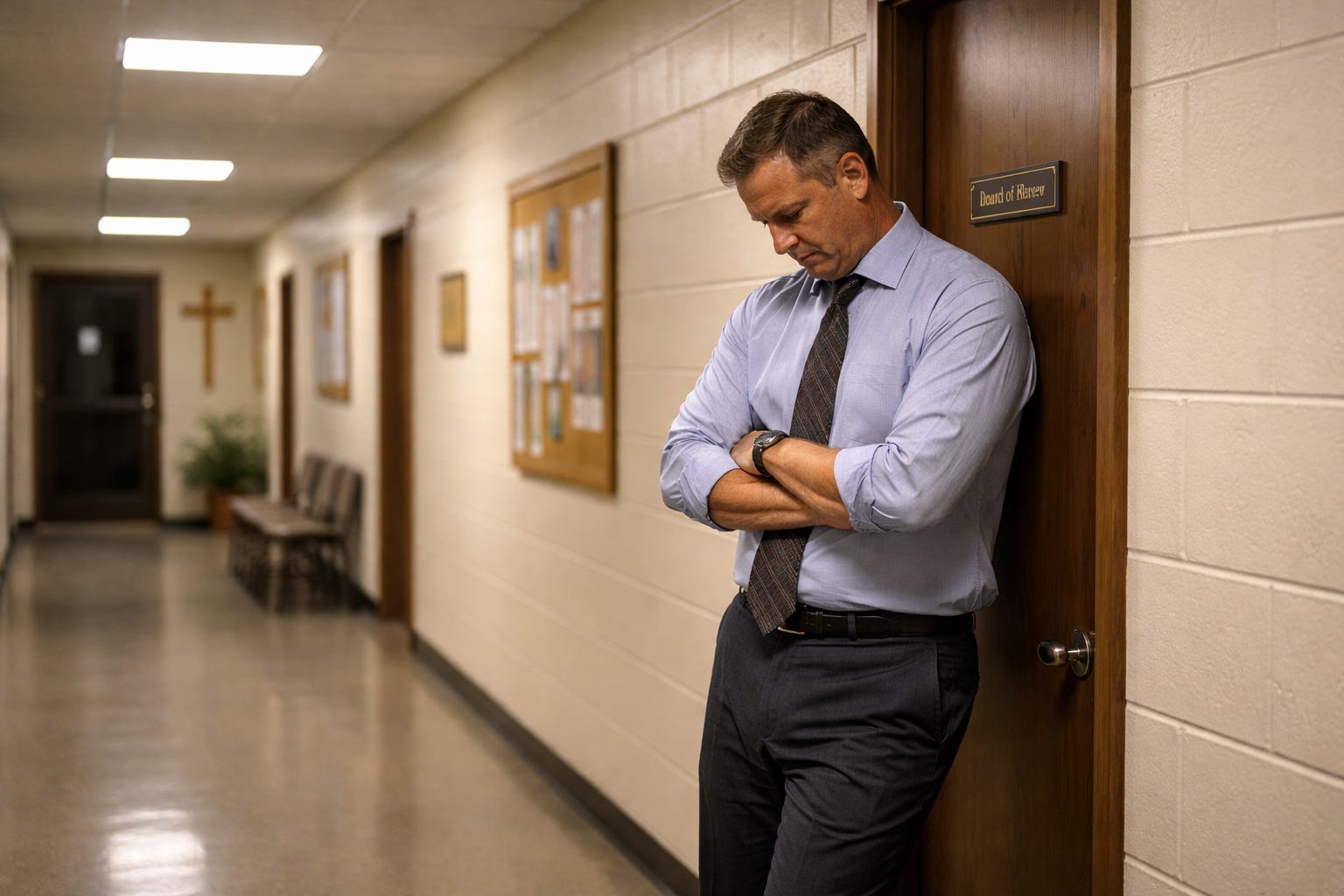
Nick sat in the hallway.
The hallway of the church was narrow and lit by fluorescent tubes that hummed at a frequency only audible when you were sitting alone and waiting for something to end. The walls were cinder block painted the color of institutional calm. There was a bulletin board with announcements for the food pantry and the women’s Bible study and a flyer for a potluck supper that had happened three weeks ago and that nobody had removed because nobody in a church ever removes a flyer. Nick sat on a folding chair beneath the bulletin board with his hands on his knees and his back straight and the posture of a man who had spent his career waiting outside rooms where things were happening.
Inside the room, his son was being reviewed for Eagle Scout.
Nick could not be in the room. Parents could not be present at the Board of Review. This was the rule, and the rule existed for the reason most rules existed, which was to protect the process from the people who loved it most, and Nick, who understood rules and who had enforced rules and who had once enforced a rule that cost a man his position and set an entire troop in motion, understood this rule and did not contest it. He sat in the hallway. He waited.
He could hear Karen’s voice through the door. Not the words. The cadence. Karen’s cadence was unmistakable: the measured pace, the deliberate pauses, the rhythm of a woman who asked questions the way a carpenter measures wood, with precision and with the understanding that the answer would determine what came next. Nick had sat in rooms where Karen asked questions. He had watched scouts answer them. He knew what Nicholas was experiencing in that room: the fluorescent light, the folding table, Karen across from him with her reading glasses and her clipboard, the other committee members flanking her, and the specific pressure of being evaluated by people who care about the outcome.
* * *
The review had started at seven. It was now seven-thirty-two.
Nick knew this because he checked his watch every four minutes, which was the interval at which a man who is not anxious checks his watch when he is anxious. The interval had been consistent. He had checked at 7:04, 7:08, 7:12, 7:16, 7:20, 7:24, 7:28, and now 7:32. Eight checks. Thirty-two minutes. The average Eagle Board of Review lasted forty-five minutes to an hour. Nicholas was, by this math, between the halfway point and the two-thirds mark, which meant the questioning was in the middle section, which was the section where Karen moved from biography and merit badges to leadership and service, the section where the questions got harder and the answers mattered more.
Corey came down the hallway with two cups of coffee. He handed one to Nick without speaking and sat in the folding chair beside him. The chairs were close enough that their shoulders nearly touched, and the nearly touching was the distance they had established over two years of sitting beside each other at campfires and in camp chairs and in the front seats of cars, the distance that was not quite contact and that was better than contact because it was chosen.
“How long?” Corey said.
“Thirty-two minutes.”
“That’s good. That means they’re past the easy stuff.”
“I know what it means.”
Corey drank his coffee. Nick drank his coffee. The coffee was from the pot in the church kitchen that Karen had started before the review because Karen started coffee before every meeting, the starting of coffee being part of the ritual that Karen performed and that nobody thanked her for and that she did not perform to be thanked.
Through the door, the cadence changed. Karen’s voice, then silence, then a voice that was Nicholas’s, longer than Karen’s, the longer answer meaning a larger question, the kind of question that could not be answered in a sentence.
“What do you think she’s asking?” Nick said.
“Leadership. What he learned from leading the project. How he handled the lumber problem. What he’d do differently.”
“The lumber problem was the best part.”
“Karen won’t say that. Karen will ask what he learned from it. The answer matters more than the solution.”
Nick looked at the door. “I arrested a man two years ago. In a parking lot. Across town.”
Corey looked at him. Nick was not looking at Corey. Nick was looking at the door behind which his son was being evaluated for the highest rank in scouting, in a troop that existed because Nick had arrested its scoutmaster, and the connection between those two facts was a line that ran through every story in the collection, through every campfire and every campout and every Tuesday meeting in this church basement, the line that connected a parking lot to a hallway, a breathalyzer to a clipboard, a man’s worst night to a boy’s best.
“I know,” Corey said.
“If I don’t pull him over, none of this happens. You don’t become scoutmaster. I don’t join the committee. Nicholas doesn’t stay in the troop. He was going to quit. After Stash.”
“I know.”
“He’s in there because I arrested a man for driving drunk. That’s the chain. That’s what connects those two things.”
Corey set his coffee on the floor beside his chair. He looked at Nick, who was still looking at the door, and he said the thing that he had understood for a long time and that he had never said because the saying had not been necessary until now, in this hallway, at this moment.
“Nick. He’s in there because he earned it. Everything you did after the arrest—the committee, the campouts, the summer camp, the vacation days—that’s not guilt. That’s you being his father. You showed up. That’s all any of us did. We showed up.”
Nick did not respond for six seconds. Six seconds in a hallway next to a man you trust is enough time for a sentence to land and settle and become part of the architecture between two people who have built something together without ever calling it what it is.
“The coffee’s not great,” Nick said.
“Karen’s coffee is never great.”
“It’s consistent. I’ll give her that.”
They drank Karen’s consistent coffee and waited in the hallway and listened to the cadence through the door.
* * *
At 7:51, the door opened.
Karen came out first. She came out the way Karen came out of every room, which was efficiently, with her clipboard and her glasses and the particular set of her shoulders that communicated everything and nothing simultaneously. She looked at Nick. She looked at Corey. She did not smile.
“You can come in,” she said.
They stood. They walked into the room. The room was the same room where Corey had run his first troop meeting and where Karen had conducted his first Board of Review and where the troop met every Tuesday, the room with the stacked chairs and the flag in the corner and the fluorescent light that made everyone look slightly more tired than they were.
Nicholas was standing behind the folding table. He was in his full Class A uniform, every badge in place, the uniform pressed, his Eagle project binder on the table in front of him, closed. He was standing straight, the way his father stood, but there was something in his face that was not his father’s, something that was only his, the expression of a seventeen-year-old who had just answered every question put to him by a woman who did not ask easy questions and who had, at the end of the answering, received something he had been working toward for six years.
Karen stood at the head of the table. The committee members sat on either side: Maria, who had joined the committee in the fall and who was present at everything because Maria was present at everything; Glen Harriman, who had driven forty minutes from the council office because Eagle Boards required council representation and because Glen, despite his humorlessness, took this seriously; and a woman from the district Corey did not recognize, who had been assigned as the external reviewer.
“The Board of Review has concluded,” Karen said. Her voice was formal. Her voice was always formal at moments like this, the formality being Karen’s version of ceremony, the understanding that certain moments required language that was larger than the people in the room. “It is my privilege to inform you that Nicholas Testa has met all requirements for the rank of Eagle Scout.”
The room was quiet for two seconds. Then Nick crossed the room. He crossed it in four steps, four steps, no motion wasted, and he put his arms around his son and held him. He held him the way he held everything, firmly and without performance, and Nicholas, who was six feet tall and who had just passed the hardest review of his life, put his arms around his father and held him back, and the holding was brief and complete and it said everything that two men who communicate in silence needed it to say.
Corey watched from the doorway. He watched his best friend hold his son and he felt the specific fullness of a man standing at the edge of someone else’s best moment, the fullness that comes from being near enough to feel it without being the one feeling it, the privilege of witness.
Karen stood at the head of the table and watched. She had seen this fourteen times. She had seen fathers hold sons and mothers hold sons and grandparents hold grandchildren and she had seen the moment land differently every time and the same way every time, the difference being the people and the sameness being the thing underneath the people, the thing that scouting was actually about when you stripped away the clipboards and the rubrics and the camping checklists and the knots nobody could tie.
She had her clipboard. She held it at her side. She did not write anything on it. There was nothing to write. The board was complete. The rank was earned. The documentation would be filed on Monday. Tonight was not about the documentation. Tonight was about the room and the father and the son and the holding and the two seconds of silence before the holding, the two seconds that were Karen’s favorite part, the part where the news lands and the world rearranges itself around the landing and everything after is different from everything before.
She would not have said this. She would have said the process was followed and the standard was met. But the clipboard was at her side and her hand was not writing and her eyes were on the father and the son and the eyes were bright, brighter than Karen’s eyes usually were, bright with the thing she would not name and did not need to.
* * *
In the parking lot, afterward, Karen gave Nicholas the council paperwork. She had prepared it in advance because Karen prepared everything in advance and because the alternative—not being prepared—was not something Karen’s nervous system could accommodate.
“Sign here,” she said. “And here. And initial here. The ceremony will be scheduled by the committee. I’ll send the family a list of what’s needed: invitations, the mentor pin, the mother’s pin, the Court of Honor program.”
Nicholas signed. Nick stood beside him, not helping, not hovering, just standing beside his son in a parking lot in the dark the way he had stood beside him at every event for two years, the standing being the thing, the being-there being the whole thing.
Karen handed the signed forms to Corey. “These go to the council with your letter of recommendation. I need the letter by Friday.”
“You’ll have it Wednesday.”
Karen almost smiled. Almost. The almost was visible to Corey because he had spent two years learning to read the almost, the way a meteorologist learns to read the sky, not by the weather that is there but by the weather that is forming.
“Wednesday,” Karen said. She walked to her car. She drove away. Her taillights disappeared down the road, steady and unhurried, the taillights of a woman driving home from the fourteenth Eagle Board of her tenure with the forms signed and the process complete and the clipboard on the passenger seat and the brightness still in her eyes, though no one was there to see it.
Nick and Nicholas walked to Nick’s sedan. Corey watched them go. Nick opened the driver’s door. Nicholas opened the passenger door. Before he got in, Nicholas looked back across the parking lot at Corey.
“Thank you, Mr. Whitman.”
The name was the name from meetings and campouts and summer camp, the formal name, the scoutmaster’s name, and Nicholas used it now, in the parking lot, in the dark, because the formality was the point. The formality said: you were my scoutmaster and you reviewed my proposal and you signed it and you were fair and the fairness mattered and I know what it cost you and I am thanking you for the cost.
“You earned it, Nicholas.”
Nicholas got in the car. Nick got in the car. The sedan pulled out of the lot and the taillights followed Karen’s taillights into the dark, two sets of lights going home, and Corey stood in the parking lot alone, in the dark, in the place where the troop met every Tuesday and where he had first walked in not knowing anyone and where he now knew everyone, and the knowing was the thing, and the coffee was still bad and the boy had made Eagle and the father had held his son and the woman with the clipboard had bright eyes.
Corey drove home.