

Training
From the "Troop 13" series

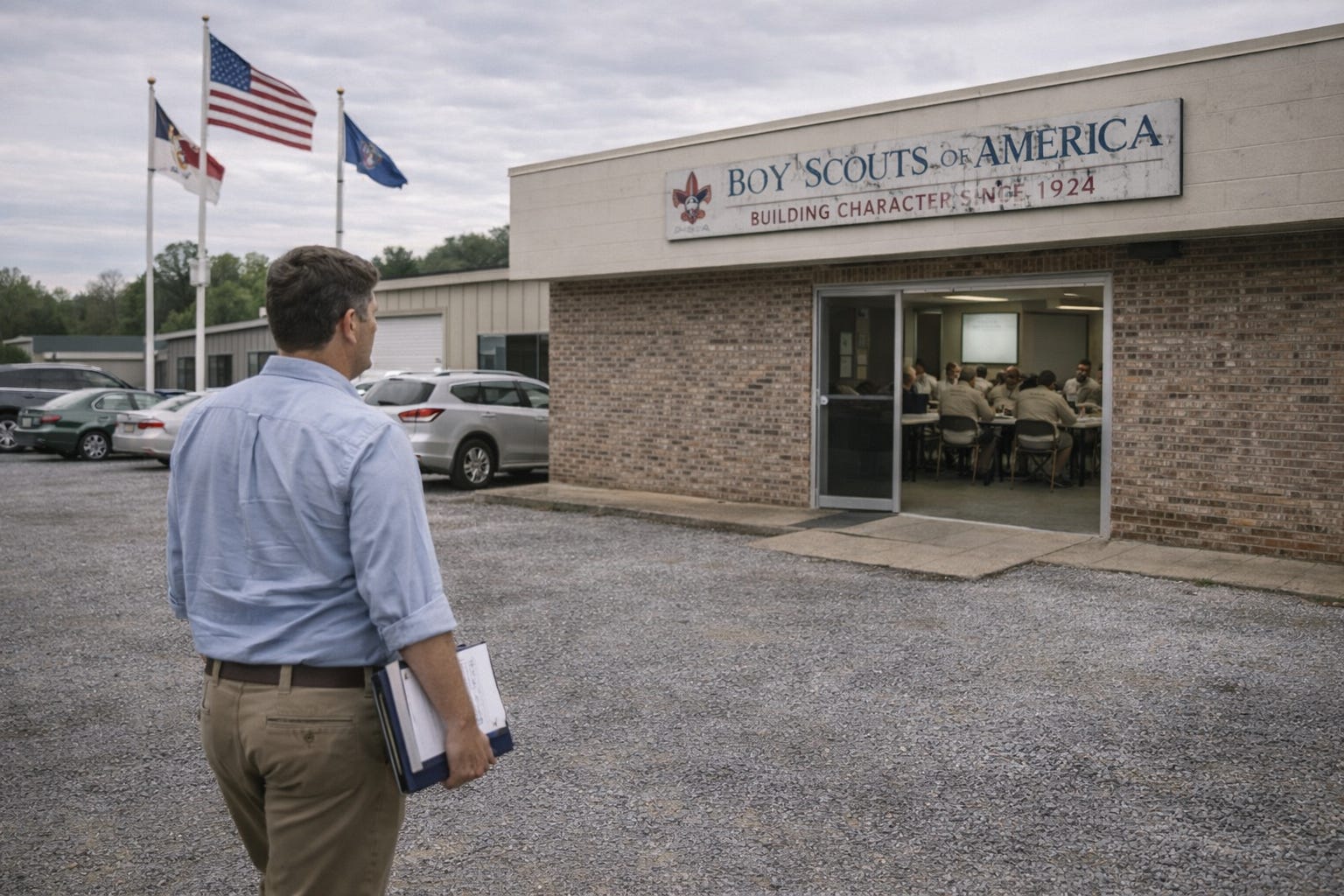
The council service center was a single-story building on a county road between a veterinary clinic and a self-storage facility, and it looked like it could have been either of those things. It had a flat roof, a gravel parking lot, and a flagpole flying the American flag and the Boy Scouts of America flag and a third flag that Corey did not recognize and that turned out to be the council’s own flag, because scouting was an institution that believed every level of its organization deserved a flag. The sign out front read BUILDING CHARACTER SINCE 1924 in letters that were missing the second A.
Corey arrived at seven-forty-five in the morning on a Saturday in June. He was wearing khaki pants and a button-down shirt, because the registration email had said “casual dress” and Corey’s version of casual dress would have been formal at most people’s weddings. He carried a notebook, a good pen, and the binder, because the binder went with him everywhere now, the way other men carried a wallet or a phone. Danny had watched him leave the apartment and said, “You look like you’re going to a job interview at a national park.”
The parking lot held a dozen cars. Corey was the last to arrive, which meant he was on time, because the email had said eight o’clock and it was seven-fifty and everyone else was already inside, which meant everyone else was the kind of person who arrived early for training on a Saturday morning in June when they could have been sleeping.
He walked in and found a room that looked like every institutional training room he had ever seen. Drop ceiling, fluorescent lights, folding tables arranged in a U-shape, a projector screen at the front, a folding table along the side wall with a coffee urn and a tray of donuts that had been purchased from a grocery store and arranged without artistry. Fifteen people sat at the tables. Fourteen of them were men. One was a woman in her fifties with a ponytail and a khaki uniform shirt covered in patches that told the story of a scouting career that predated most of the men in the room. Every person was wearing some combination of khaki and olive drab, as if a dress code had been circulated that Corey had not received.
He was the only person in the room in a button-down shirt. He was the only person carrying a notebook that was not spiral-bound. He was, he understood within the first thirty seconds, the only person in the room who did not look like he belonged there.
* * *
The lead instructor was a man named Gary Furlong. He was in his sixties, compact, with a silver beard and a uniform so thoroughly decorated with patches and pins and insignia that it functioned less as clothing and more as a résumé. He had been a scoutmaster for twenty-three years. He had trained over four hundred leaders. He had opinions about lashing techniques that he would share at length if given the opportunity, and the opportunity would arrive several times before lunch.
Gary opened the session at eight o’clock with a brief introduction. Everyone would state their name, their troop number, their years of experience, and one thing they hoped to learn. This was, Gary said, an icebreaker. Gary said the word “icebreaker” without irony, which Corey appreciated, because the people who say “icebreaker” without irony are the people who actually believe in icebreakers, and that kind of sincerity, in a room full of men who had given up their Saturday to learn about Scout leadership, was something Corey understood. He taught college freshmen. He knew what earnest instruction looked like when it was not being appreciated, and he knew what it looked like when it was.
The introductions moved around the U. Troop 8, eleven years. Troop 22, six years. Troop 45, fifteen years, here to recertify. Troop 19, three years, here because his wife said he had to. Laughter. Troop 31, twenty years, assistant scoutmaster, here to finally get the credential he should have gotten a decade ago. Each man gave his troop number the way soldiers give their unit, with an identity attached, a shorthand for who they were and where they came from. The woman was from Troop 60, which had gone coed two years earlier, and she had been involved in scouting for thirty-one years, longer than anyone in the room, and she said so without emphasis because she did not need to emphasize it.
The introductions reached Corey.
“Corey Whitman. Troop 13. Three months.”
A man across the table made a sound. It was small, barely a sound at all, more like the ghost of a sound, the kind of involuntary exhalation that happens when a person hears something they recognize. Another man glanced at the first man. A third man, two seats to Corey’s left, leaned back in his chair with the expression of someone who has just placed a face, except he was not placing a face. He was placing a troop number.
“Three months,” Gary said, writing it down. “Welcome. What do you hope to learn today?”
“Everything,” Corey said. “I don’t have a scouting background. I’m an art professor. I became scoutmaster because my son joined and no one else would do it. I’ve read the handbook and I’ve been studying the binder my committee chair gave me, but I’m aware that there’s a significant gap between reading about it and doing it.”
He said all of this in his normal voice, which was the voice of a man who said honest things without performing them. The room recalculated. The man who had made the sound was looking at Corey differently. The woman from Troop 60 was looking at him with something that might have been recognition, not of him specifically, but of the type: the parent who fell into it, who had no background, who was here because he cared enough to show up. She had seen them before. Most of them didn’t last. The ones who did were usually the best leaders in the district, because they had nothing to unlearn.
* * *
The morning session covered the fundamentals: the aims and methods of scouting, the role of the scoutmaster, Youth Protection policies, the organizational structure of a troop. Gary taught with the mix of authority and repetition that comes from having delivered the same material hundreds of times. He used flip charts. He used acronyms. He used the phrase “the patrol method is the foundation of everything we do” four times before the first break, and each time he said it he looked at the room the way a preacher looks at a congregation, searching for the faces that were hearing it and the faces that were enduring it.
Corey took notes. He took notes on the patrol method, on the difference between boy-led and adult-led, on the advancement process, on the outdoor program. He wrote in his notebook with his good pen, in the careful handwriting he used for everything, and the man next to him, a veteran scoutmaster from Troop 22, glanced at the notebook twice during the first hour with the expression of a man watching someone take a painting class at a hardware store. The notes were meticulous. The pen was too nice. The handwriting was too neat. Nothing about Corey matched the room, and yet he was the most attentive person in it, and this was a contradiction that the man from Troop 22 could not resolve, so he stopped looking.
The break came at ten-fifteen. Coffee was replenished. Donuts were revisited. Men stood in clusters of two and three, holding Styrofoam cups, talking about their troops the way mechanics talk about engines, with the intimate familiarity of people who spend their time inside the machinery.
Corey filled a cup of coffee and stood near the donut table, which was where you stood when no cluster had invited you in yet. A man approached him. He was tall, fit, with a posture that suggested either military service or an aggressive commitment to spinal alignment. His uniform was pressed. His troop numbers were displayed on his sleeve with the exactness of someone who considered the placement of a patch to be a moral act. He looked like a man who had never been late for anything and who considered lateness to be a character deficiency rather than a scheduling error.
“Ted Callaway,” he said, extending his hand. “Troop 9.”
“Corey Whitman. Troop 13.”
Ted’s handshake was firm in the way that handshakes are firm when the firmness is the point. “Troop 13,” he repeated. Something happened on his face, a microadjustment, the kind of change that Corey’s trained eye caught because his trained eye caught everything. It was not a smirk. Ted Callaway was too disciplined for a smirk. It was the faintest reorganization of features that a person makes when they hear a name they know and have opinions about.
“You took over from Stash,” Ted said. It was not a question.
“I did.”
“How’s that going?”
It was the kind of question that sounded open but was shaped like a test. How Corey answered would determine how Ted Callaway categorized him, and Corey could feel the categorization happening in real time, the way you can feel someone measuring you for a suit they’re not sure you can afford.
“It’s a work in progress,” Corey said. “The troop has some catching up to do.”
“The troop has a lot of catching up to do,” Ted said, and the correction was gentle but absolute, the way a teacher corrects a student’s grammar. “Stash ran that troop into the ground. No offense. I know he’s your assistant now, and he knows scouting, I’ll give him that. But that troop hasn’t participated in a district activity in three years. No camporee, no Scouting for Food, no representation at roundtable. When Troop 13 comes up at district meetings, it comes up as a cautionary tale.”
Corey stood by the donut table holding his Styrofoam cup and absorbed this. He had known the troop was struggling. He had seen the evidence firsthand: the boys who couldn’t cook, the absent flag ceremony, the campouts that Stash had run like a catering service. But hearing it from the outside, from a man who represented the rest of the district, was different. It was the difference between knowing your house needs work and hearing a neighbor say your house is the one they point to when explaining property values.
“I’m here to change that,” Corey said.
Ted studied him. He was performing the assessment that men like Ted Callaway performed on everyone, the rapid sorting of a person into categories of competence. Art professor. No scouting background. Three months of experience. Button-down shirt. Nice pen. The data did not support the claim.
“Good luck,” Ted said. He said it the way people say “good luck” when they mean “you’ll need it,” and he walked away to rejoin a cluster of scoutmasters who greeted him with the deference of men who had been losing to his troop for years.
Corey stood alone by the donuts. He took a sip of his coffee. It was bad coffee, the institutional kind, brewed too long ago and kept warm by a heating element that was performing a kind of slow cremation. He drank it anyway. He thought about what Ted had said. Cautionary tale. He thought about the boys, his boys, Scott and Diego and Owen and the others, who did not know they were a cautionary tale, who did not know that when their troop number was spoken at district meetings it was spoken the way you speak the name of a team that hasn’t won in years.
He went back to his seat. He opened his notebook. Gary was resuming the session. The topic was the patrol method.
* * *
Gary Furlong taught the patrol method the way evangelists teach the gospel: with conviction, with repetition, and with the absolute certainty that the people listening had heard it before and were not doing it.
“The patrol method,” Gary said, standing at the front of the room with a flip chart that had been used so many times the paper was soft, “is not a suggestion. It is not an option. It is the method. It is how a Boy Scout troop operates. If you are not using the patrol method, you are not running a troop. You are running a day care.”
He explained it systematically. The troop was divided into patrols of six to eight boys. Each patrol had a patrol leader, elected by the boys. The patrol leaders met in a patrol leaders’ council, led by the senior patrol leader, to plan meetings and activities. The boys planned their own menus. The boys purchased their own food. The boys cooked their own meals. The boys decided where they wanted to camp, what merit badges they wanted to work on, what service projects they wanted to do. The adults supervised. The adults advised. The adults did not do the work.
Gary pointed at the flip chart. “If you are planning the menus, you are doing it wrong. If you are buying the food, you are doing it wrong. If you are cooking the food, you are doing it wrong. If you are standing at a campsite making decisions that the boys should be making, you are doing it wrong. Your job is to train them, support them, and get out of the way.”
Corey wrote it all down. He wrote down every word about the patrol leaders’ council. He wrote down the part about the boys planning menus and purchasing food. He wrote down the part about the boys cooking, and as he wrote it he saw Stash standing at the folding table on the April campout, fishing hot dogs out of a pot while the boys stood around and waited to be served. He saw four years of campouts he had not been present for but could now imagine: Stash cooking, Stash planning, Stash making every decision, the boys showing up and being fed and going home and learning nothing about self-reliance because nobody had asked them to be self-reliant.
He understood now what Karen had not seen. The troop’s patrols existed on paper. The patrol leaders had been assigned. The structure was there, in the same way that a house’s framing is there after the walls have rotted: you could see the shape of what it was supposed to be, but nothing was connected and nothing worked. Stash had never held a patrol leaders’ council. He had never asked the boys to plan a menu or purchase food or cook a meal. He had never held a Court of Honor on time or filed an advancement report before Karen reminded him or submitted a tour plan before a campout. He had run the troop the way he ran his life, on instinct and inertia, doing the things he enjoyed (campfires, stories, being liked by the boys) and neglecting the things he didn’t (paperwork, process, the slow, unglamorous work of teaching twelve-year-olds to feed themselves).
Gary was still talking. “The hardest thing you will do as a scoutmaster is not lead. It is step back. It is watch a thirteen-year-old burn a pot of rice and not take the spoon out of his hand. It is let a patrol leader run a meeting badly and then talk to him afterward about what he could do better. The program works when the boys fail and learn. It does not work when the adults succeed for them.”
Corey underlined this in his notebook. He underlined it twice.
* * *
The afternoon session was outdoor skills. Gary moved the group to a patch of grass behind the building, between the service center and the self-storage facility, and taught them to set up a patrol camp, build a fire lay, and use a compass. He taught knots. He taught lashings. He spent twenty minutes on the bowline, which he called “the king of knots” with the reverence of decades of calling it that and would continue calling it that until he died.
Corey could not tie a bowline. He tried. He tried the way he tried everything, with focus and care and the patient conviction that skill would yield to effort. It did not yield. The rope did not cooperate. His fingers, which could shade a charcoal drawing with precision and mix colors that matched the exact blue of an October sky, could not form the loop and pass the end through and around and back in the sequence that Gary demonstrated three times and that every other person in the group executed on the first or second attempt.
The woman from Troop 60 tied hers without looking down, the way a pianist plays scales. Ted Callaway tied his with one hand, which was showing off and which everyone knew was showing off and which Ted did anyway because Ted Callaway was the kind of man who tied a one-handed bowline at a training session. The man from Troop 22 tied his quickly and then watched Corey struggle with the benign curiosity of a person watching someone attempt a task they find elementary.
Gary came to Corey. He looked at the tangle of rope in Corey’s hands. He did not laugh. He did not look impatient. He took the rope, undid the mess, and started over, slowly, narrating each step. “The rabbit comes out of the hole, goes around the tree, and goes back in the hole.”
“The rabbit,” Corey said.
“The rabbit. The working end is the rabbit. The standing part is the tree. The loop is the hole.”
Corey tried again. The rabbit came out of the hole. The rabbit went around something that may or may not have been the tree. The rabbit did not go back in the hole. The rabbit got lost.
Gary looked at Corey’s rope. He looked at Corey. “What did you say you do for a living?”
“I’m an art professor.”
Gary nodded slowly, like a puzzle piece had just clicked—information that explained a great deal. “You’ll get it,” he said, with a kindness that suggested he was not entirely sure this was true.
They moved on to fire building. Corey was better at this than knots, though the bar was on the ground. He built a fire lay that Gary described as “creative,” which was, Corey suspected, not the word Gary usually used. But the fire lit. It burned. It did what a fire was supposed to do, and Corey felt the small, specific satisfaction of a man who had made something work with his hands in front of people who expected him to fail.
The compass work was fine. Navigation was spatial, and Corey’s brain was spatial. He read the map the way he read a canvas, seeing relationships between forms, understanding how the contour lines described a landscape he could visualize without standing in it. Gary noticed this. “You’re good with the map,” he said, and Corey heard in his voice the genuine surprise of a man who had just discovered that the art professor who could not tie a bowline could read terrain like a topographer.
* * *
The last exercise of the day was a patrol project. Gary divided the group into three patrols of five, assigned each patrol a task, and told them they had thirty minutes. It was a simulation. The point was to experience the patrol method from the inside, to feel what the boys felt when they were asked to work as a team with a leader and a plan and a deadline.
Corey’s patrol was assigned to design and present a patrol flag. The flag could be made from any materials available, which meant paper and markers and tape and whatever else the service center’s supply closet contained. The patrol leader was a man from Troop 19, the one whose wife had made him come, and he stood in front of his four patrol members with the blank expression of unwanted responsibility and did not know how to execute.
“So,” the patrol leader said. “A flag.”
The group looked at each other. Three men shrugged in near-unison. Corey looked at the materials: poster paper, a box of markers, masking tape, a pair of scissors. He looked at the poster paper the way he looked at a blank canvas, which was to say with possibility.
“Can I?” he asked the patrol leader.
“Please.”
Corey sat down at the table and went to work. He sketched a design in pencil first, quickly, the way he sketched in class when demonstrating a concept: a patrol emblem, bold and simple, with a name they chose together (the patrol leader suggested “Wolverines” because his son liked wolverines, and nobody objected) and a layout that used the full space of the poster paper without crowding it. He selected colors from the marker box, rejecting three reds before finding one with the right saturation. He drew the outline freehand, steady and sure, and then he filled it in with focused attention, operating for the first time all day in his native language.
The other patrol members watched. They had been skeptical. The art professor who could not tie a bowline was not, in their estimation, going to be the person who saved the flag exercise. But the flag was taking shape, and it was good. It was not just good. It was striking. The lines were clean. The colors were balanced. The design had the professional quality of something made by a person who understood visual communication, because that was exactly what Corey understood. He understood how to make something that caught the eye and held it, how to use space and color and proportion to say something without words.
The patrol leader stared at the flag. “You made that in twenty minutes?”
“The design is simple,” Corey said. “Simple designs are usually the strongest.”
When the patrols presented their projects at the end of the session, Corey’s patrol flag drew a reaction the other projects did not. Gary held it up and looked at it the way he had looked at the bowline, except this time his expression moved in the other direction. Ted Callaway looked at it from across the room and said nothing, which was Ted Callaway’s way of acknowledging that something had exceeded his expectations.
The woman from Troop 60 caught Corey in the parking lot afterward. “That flag was something,” she said.
“Thank you.”
“You can’t tie a bowline to save your life, but you can make a patrol flag that looks like that.” She smiled. “Your troop is lucky. They just don’t know it yet.”
* * *
Corey drove home in the late afternoon with the windows down and the radio off, which was unusual because the radio was never off. The radio was always playing something, a cast recording, a Garland album, the soundtrack to whatever musical was living in his head that week. Today the car was quiet because Corey was thinking, and when Corey was thinking seriously he needed silence the way other people needed caffeine.
He was thinking about the patrol method. He was thinking about Gary’s words: the hardest thing you will do is not lead. It is step back. He was thinking about Stash at the folding table, cooking for boys who should have been cooking for themselves. He was thinking about Scott, who was quiet and anxious and stood at the edges of things, and how the patrol method, if it worked, would require Scott to step into the middle. To plan a meal. To cook it. To fail and try again. The thought terrified Corey on behalf of his son, which was exactly the instinct the patrol method was designed to override.
He was thinking about Ted Callaway saying “cautionary tale.” He was thinking about the men who had heard his troop number and made sounds. He was thinking about three years of absence from district activities, three years of Stash canceling campouts for suspicious clouds, three years of a troop that existed on Karen’s spreadsheet but had stopped functioning as a program.
He was thinking about a patrol flag.
He pulled into the apartment parking lot. Danny’s truck was there. The landlord’s garden gnomes stood in their eternal formation on the front lawn. The apartment was upstairs, waiting, with the kitchen table and the binder and the felt-tip pen and the student portfolios and the coffee mug with the Sondheim quote. His two lives, side by side on the same table, competing for the same hours.
Danny was on the couch, naturally. Basketball game. Beer. Gym shorts. The apartment smelled like something Danny had grilled on the small charcoal grill they kept on the back landing, which Danny used for cooking and Corey used for nothing because Corey did not grill. Corey’s contribution to the apartment’s cuisine was pasta, roasted vegetables, and the occasional risotto that Danny ate without complaint but also without enthusiasm.
“How was Boy Scout school?” Danny asked.
“I can’t tie a bowline.”
“What’s a bowline?”
“A knot. The king of knots, apparently. I can’t tie it. I tried six times. The instructor watched me like I was performing surgery with oven mitts.”
Danny grinned. “What can you do?”
“I can make a patrol flag. I can read a map. I can build a fire lay that the instructor called ‘creative,’ which I think was a euphemism.”
“So you’re the guy who can’t tie a knot but can make a flag.”
“That appears to be my brand.”
Danny took a pull of his beer. “There are worse brands.”
Corey set his notebook on the kitchen table, next to the binder and the portfolios. He sat down. He opened the notebook to the pages of notes he had taken, eight pages, front and back, in his careful handwriting. Danny looked over from the couch and saw the notebook and the binder and the open pages and the pen in Corey’s hand, and he didn’t say anything, because Danny knew what it looked like when Corey was working, and Corey was working.
“Our troop is a joke,” Corey said, not looking up. “The whole district knows it. They hear our troop number and they make faces. A guy told me we’re a cautionary tale.”
Danny muted the basketball game. He didn’t say anything right away. He sat with it the way Danny sat with things that mattered, quietly, letting the weight of it settle before responding.
“Were you a cautionary tale three months ago?” Danny asked.
“No. Three months ago I was an art professor who didn’t know what a crossing-over ceremony was.”
“So the troop was a cautionary tale before you. And now you know about it. And you’re sitting there with a notebook full of notes and a pen that costs more than my sunglasses, and you’re going to fix it.”
Corey looked at him. Danny was leaning back on the couch with his beer in one hand and the remote in the other, delivering life clarity in gym shorts, which was Danny’s way. He did not dress his observations in careful language. He simply said what he saw, the way a man calls a ball fair or foul, without analysis, because the call was obvious.
“Yeah,” Corey said. “I’m going to fix it.”
Danny unmuted the basketball game. Corey picked up his pen. He turned to a fresh page in the notebook and at the top he wrote, in the careful handwriting that was too neat for a training session but exactly right for the beginning of something: TROOP 13 — WHAT NEEDS TO CHANGE.
He began to write. The list was long. The apartment was quiet except for the basketball game and the scratch of the pen. Outside, the June evening was warm and long and full of light, the kind of light that lasts until nine o’clock and makes you feel like the day is giving you extra time, which is what Corey needed, because the distance between where Troop 13 was and where it needed to be was not going to close itself, and the man at the kitchen table, the one with the good pen and the patrol flag that had silenced a room, was the only one who was going to close it.
Sweet!