

Trust Me

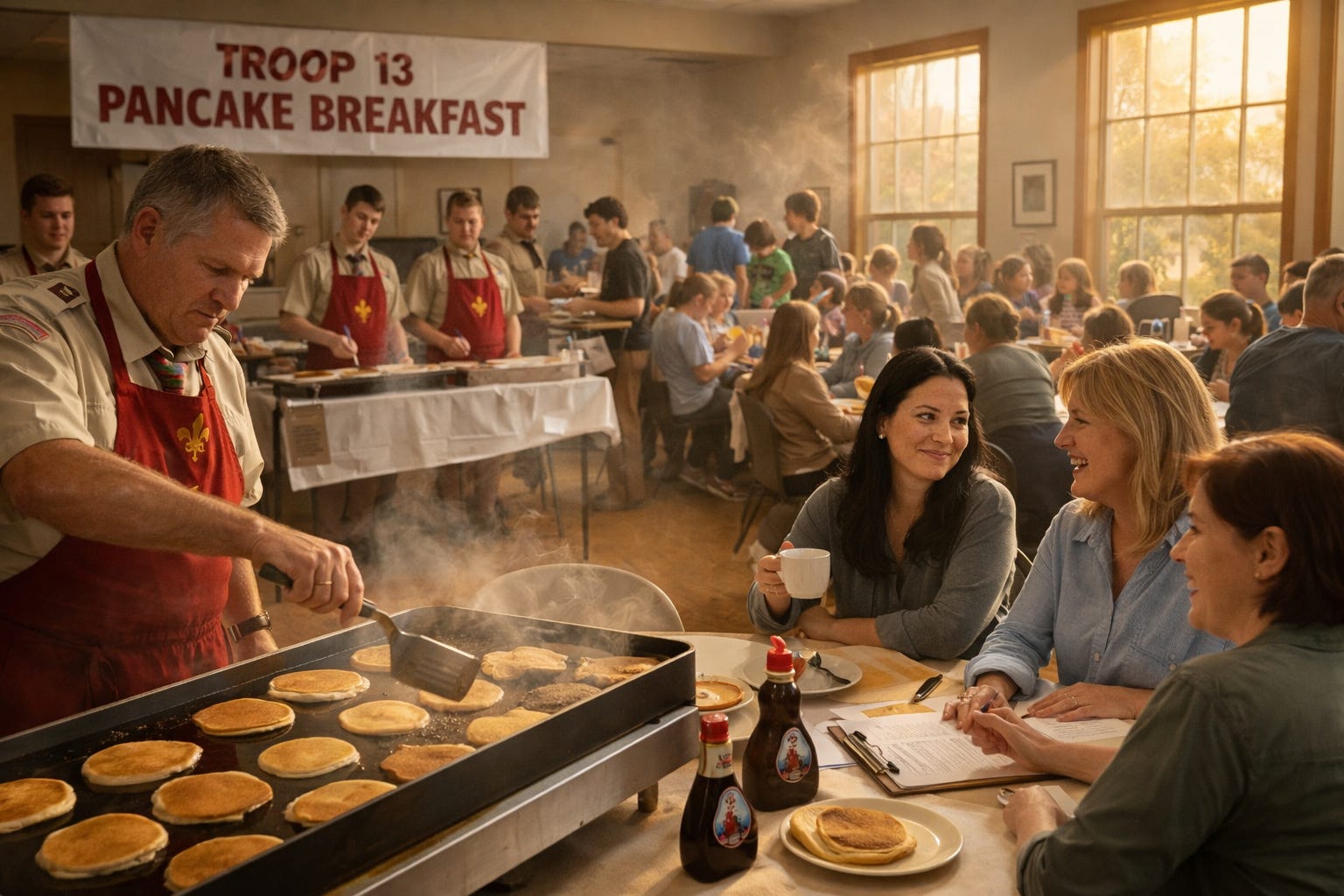
The pancake breakfast was Maria’s idea.
She had proposed it at the October committee meeting with the quiet authority of a woman who had been doing twice the work of everyone else for a year and who had earned the right to propose things without defending them. Pancake breakfast. Saturday morning. The church fellowship hall. Scouts cook, parents serve, community eats. Tickets five dollars, kids under five free. Maria had already secured the donated pancake mix, the sausage, the orange juice, and the use of the fellowship hall kitchen, which she had arranged through a conversation with the church secretary that Corey imagined had lasted approximately ninety seconds, because Maria did not waste time and the church secretary did not waste time and two women who did not waste time could arrange the use of a kitchen in the time it took other people to find the church secretary’s phone number.
The fellowship hall was full by eight-thirty. Forty families. A line at the serving table. Scouts in aprons that were too large, flipping pancakes with the attention span and the spatula control of twelve-year-olds, which meant the pancakes were irregular and the floor was slippery and Parker had already dropped a sausage link that rolled under the serving table and that he was now eating because Parker operated on a five-second rule that he had extended, through practice, to approximately forty-five seconds.
Corey was at the griddle. He was the griddle man because he was good at it, a fact that surprised no one who understood that making pancakes was a visual art—the batter poured at the right diameter, the bubbles read for the flip, the golden-brown achieved through patience rather than heat—and Corey’s eye, the eye that made patrol flags and directed campfire skits, made pancakes that were uniform and golden and stacked with care, believing that even a five-dollar pancake deserved to be made well.
Jennifer was at the coffee station. She had volunteered because new parents volunteered and because coffee was a thing Jennifer understood the way Corey understood pancakes: not as a beverage but as a system, a sequence of grind and temperature and timing that produced a result, and the result was that the coffee at the Troop 13 pancake breakfast was better than the coffee at any other troop event in the history of the district, a standard nobody had asked for and that Jennifer had established anyway.
Karen was everywhere. Karen at a fundraiser was Karen at maximum operational capacity: clipboard, apron, reading glasses on a chain, moving between the kitchen and the serving line and the cash box and the door. She counted heads. She counted plates. She counted cash in intervals that suggested she was maintaining a running total in her head and that the total was either on target or not, and that if it was not, someone was going to hear about it.
The breakfast was going well. The breakfast was going well because Maria had organized it and Corey had staffed it and Karen had controlled it, the three of them operating in a configuration that had taken two years to develop and that worked not because they agreed on everything but because they had learned where the agreements were and had stopped fighting about the rest.
* * *
It happened at the coffee station.
The line had thinned. The second wave of families had been served, the scouts were eating their own pancakes in the corner with the velocity of boys who had been cooking for two hours and who were now addressing the caloric deficit with professional urgency. Jennifer was wiping down the coffee station. Karen was standing nearby, clipboard at her side, in the specific posture of a general surveying a field after the battle.
“Good turnout,” Jennifer said.
“Forty-three families. Up from thirty-one last year.” Karen paused. “The coffee helped.”
From Karen, this was equivalent to a standing ovation. Jennifer received it without visible reaction, the way a person receives a compliment from someone whose compliments are rare and therefore heavy.
“Corey’s been good for this troop,” Jennifer said, and the saying of it was casual, the way you say a thing that is obvious and that does not require defense.
Karen looked at the griddle. Corey was making pancakes. He was making them with the focus and spatial awareness of someone who arranged things for a living, and the pancakes were perfect, and the boys around him were laughing, and the apron he was wearing had the troop number on it and he wore it the way he wore everything, as if it had been chosen rather than assigned.
“He’s certainly committed,” Karen said. “I didn’t expect that. When he started.”
“What did you expect?”
Karen considered this. Karen considered things the way she considered everything: carefully, with the awareness that the words she chose would be the words that existed in the air afterward and that the air would hold them whether she wanted it to or not.
“He’s not what we usually get,” Karen said. “As a scoutmaster. He’s very…” She searched for the word. The search was visible, the way a person’s search for a word is visible when the words they are avoiding are louder than the word they are looking for. “Artistic.”
Jennifer poured herself a cup of coffee. She poured it slowly, the way she did things when she was thinking, which was slowly and without rushing, because Jennifer did not rush toward other people’s discomfort. She let it arrive. She let it sit in the room. She gave it the time it needed to become visible.
“Artistic,” Jennifer repeated.
“He has a different approach. The flags. The skits. The way he dresses.” Karen’s voice had careful neutrality, saying one thing and meaning another, aware that the other thing was present in the room but who could not name it directly because naming it would make it real and making it real would require her to account for it. “He’s very different from Stash.”
“Everyone is very different from Stash.”
“True.” Karen almost smiled. “He and Danny seem close.”
There it was. The turn. The sentence Karen had been building toward, laid on the counter between them like a card turned face-up. He and Danny seem close. The sentence was not about Danny. The sentence was not about closeness. The sentence was about the thing Karen had been circling for two years, the thing she had never said out loud, the thing that lived in her pauses and her word choices and the way she watched Corey a beat too long at troop events. She and Danny seem close. The architecture of suspicion, built one observation at a time, delivered now to a woman Karen had assessed as competent and trustworthy and who might, Karen hoped, confirm or deny the thing Karen could not bring herself to ask.
Jennifer took a sip of her coffee. She set it down. She looked at Karen, and the look was not hostile and not defensive and not offended. It was the look of a woman who had understood the conversation from the moment Karen said “artistic,” who had heard the undertone in every subsequent sentence, and who had been waiting for the turn patiently, as if she knew where the conversation was going and was willing to let it arrive there on its own schedule.
“Danny is Corey’s roommate,” Jennifer said. “They’ve been friends since college. Danny coaches basketball at the middle school. He’s between girlfriends roughly every six weeks, which is exhausting for everyone in the apartment.” She paused. Took another sip. “And trust me, Corey’s definitely not gay.”
She said it the way you say something that is so obvious to you that the saying of it is almost a formality, the way a person says the sky is blue or Tuesday comes after Monday, a fact so fundamental to her experience that the idea of someone not knowing it was faintly amusing. Not cruel. Amused. The amusement of a woman who had spent the last six months in Corey Whitman’s company and who found the suggestion that he might be gay so completely at odds with her personal experience that the gap between the suggestion and the reality was, to her, genuinely funny.
Karen did not speak for four seconds. Four seconds is not a long time in most conversations. It is a very long time in a conversation where the thing you have believed for two years has just been picked up and set down somewhere else, gently, without malice, by a woman who is drinking coffee and who appears to find the whole thing mildly entertaining.
Karen could not ask how Jennifer knew. Asking how Jennifer knew required admitting that she had been thinking about it, and admitting she had been thinking about it required admitting that the thinking had informed her behavior, and the behavior had informed two years of watching and assessing and filing observations about a man who had been, the entire time, exactly what he appeared to be: a man who dressed well and liked musicals and made excellent pancakes and was a good scoutmaster and was not gay.
“Well,” Karen said. “The coffee really is very good.”
She picked up her clipboard. She walked back to the cash box. Jennifer watched her go and took another sip of coffee and did not smile, or did not smile visibly, the difference being important because the smile that was happening was happening on the inside and was large enough that containing it was an act of discipline that Jennifer was performing out of respect for a woman who had just had two years of assumptions removed from beneath her in the time it took to drink a cup of coffee.
* * *
Jennifer told Corey that afternoon, in her kitchen, while Tyler was in the backyard attempting to build a fire pit out of landscaping bricks and determination.
She told it as a story. She told it the way she told all stories, which was well, with timing and detail and the comedian’s instinct for where the laugh was and how long to hold the pause before delivering it. She did Karen’s voice. She did Karen’s pause. She did the four seconds of silence and the pivot to the coffee, and by the time she was done Corey was sitting at her kitchen table with his hands flat on the surface and his mouth slightly open and the expression of someone who has just learned something about himself that everyone else apparently knew and that he did not.
“She thinks I’m gay,” Corey said.
“Thought. Past tense. I fixed it.”
“She’s thought I was gay for two years.”
“Corey.”
“Two years. Every meeting. Every campout. Every Board of Review and camporee and email about the checklist. She’s been watching me because she thinks I’m—”
“Corey.”
“The show tunes. It’s the show tunes.”
“It’s not just the show tunes.”
“It’s the clothes. And Danny. And the—” He stopped. He looked at his hands on the table. He looked at the kitchen. He looked at Jennifer, who was leaning against the counter with her arms crossed and her coffee in her hand, enjoying this more than she should and not guilty about it at all.
“This is funny to you,” Corey said.
“This is the funniest thing that has happened in my entire life.”
“I have been giving that troop everything I have. Training. Wood Badge. Summer camp. I redesigned the patrol flags. I can’t tie a bowline but I can run a campfire program that makes grown men cry. I have given her everything, and the entire time she’s been—”
“Corey.” Jennifer’s voice was different now. Softer. She set down her coffee and walked to the table and sat across from him. “Listen to me. She wasn’t watching you because she thought you were gay. She was watching you because she thought you were gay and she was waiting for it to be a problem and it never was. You showed up every Tuesday. You ran every campout. You went to Wood Badge. You were never a problem. You were exactly the scoutmaster those boys needed, and she spent two years trying to find the flaw and the flaw wasn’t there.”
Corey was quiet. The kitchen was quiet. Outside, Tyler dropped a landscaping brick on his foot and said a word that traveled through the window and into the kitchen and that neither of them acknowledged.
“She said I’m committed,” Corey said. “Jennifer said Karen told her I’m committed.”
“She did.”
“That’s what she said before the—before the Danny thing. She said she didn’t expect it. My commitment.”
“That part was real, Corey. That part was Karen McKay telling me she was wrong about you without using the word wrong, which is the closest Karen McKay gets to an apology, and it’s closer than most people get.”
He sat with it. He sat with the knowledge that for two years the woman who ran his committee had been watching him through a lens he hadn’t known existed, that the lens had colored every interaction, every clipboard note, every compliment that arrived with conditions, and that the lens had been removed in a conversation he wasn’t part of, by a woman he was in love with, over coffee at a pancake breakfast. The architecture of it was absurd. The feeling of it was not absurd. The feeling was the feeling of a man who has been seen incorrectly by someone whose opinion he values and who did not know he valued it until the seeing was corrected and the correction left a space where the seeing had been, an empty space shaped like two years of effort that had been received through a filter he could not have imagined and could not have removed.
“Does she know about us?” Corey asked.
“No. But she’s Karen. She’ll figure it out. Probably already has.”
“When she figures it out, the gay thing goes away completely.”
“The gay thing is already gone. I killed it. At the coffee station. With a sentence.” Jennifer smiled. “You’re welcome.”
Corey looked at her. He looked at this woman at his kitchen table who had done the thing he could not have done for himself, who had read a situation in three minutes that he had missed for two years, who had defused it without cruelty and without drama and with the precise, casual deployment of a truth that was, to her, so obvious it barely required saying. He looked at her and he understood why he loved her, not because of this, not because she had fixed the Karen problem, but because she saw the world clearly and she moved through it with a competence that did not require applause and a humor that did not require an audience, and she had chosen him, which was the part he still could not fully account for and which he had decided to stop questioning and to simply hold.
“Thank you,” he said.
“For telling you?”
“For everything. For the coffee station. For knowing what she was asking. For answering it the way you did.”
“I didn’t do it for you,” Jennifer said. “I did it for her. She needed to stop looking for the wrong thing so she could start seeing the right one. The right one is standing at a griddle making perfect pancakes for her troop, and he’s been there the whole time, and she almost missed him.”
Tyler came in from the backyard. His hands were dirty. His face was dirty. He was grinning.
“The fire pit’s done,” he said. “It’s a little crooked.”
“How crooked?” Jennifer asked.
“Like, structurally.”
Jennifer looked at Corey. Corey looked at Jennifer. The look contained the entire afternoon: the kitchen, the conversation, the two years, the pancakes, the coffee, the sentence, and now a twelve-year-old with a crooked fire pit, and the Tyler of it all was the best part.
“We’ll fix it tomorrow,” Corey said, and the “we” was the word he had been keeping in his private vocabulary since September, the word that had been forming in the space between Mr. Whitman and the thing that came after, and he said it now, in Jennifer’s kitchen, to Jennifer’s son, and the word was out and the word was right and nobody in the room remarked on it because the people in the room already knew what it meant.