

Voluntold
From the "Troop 13" Series

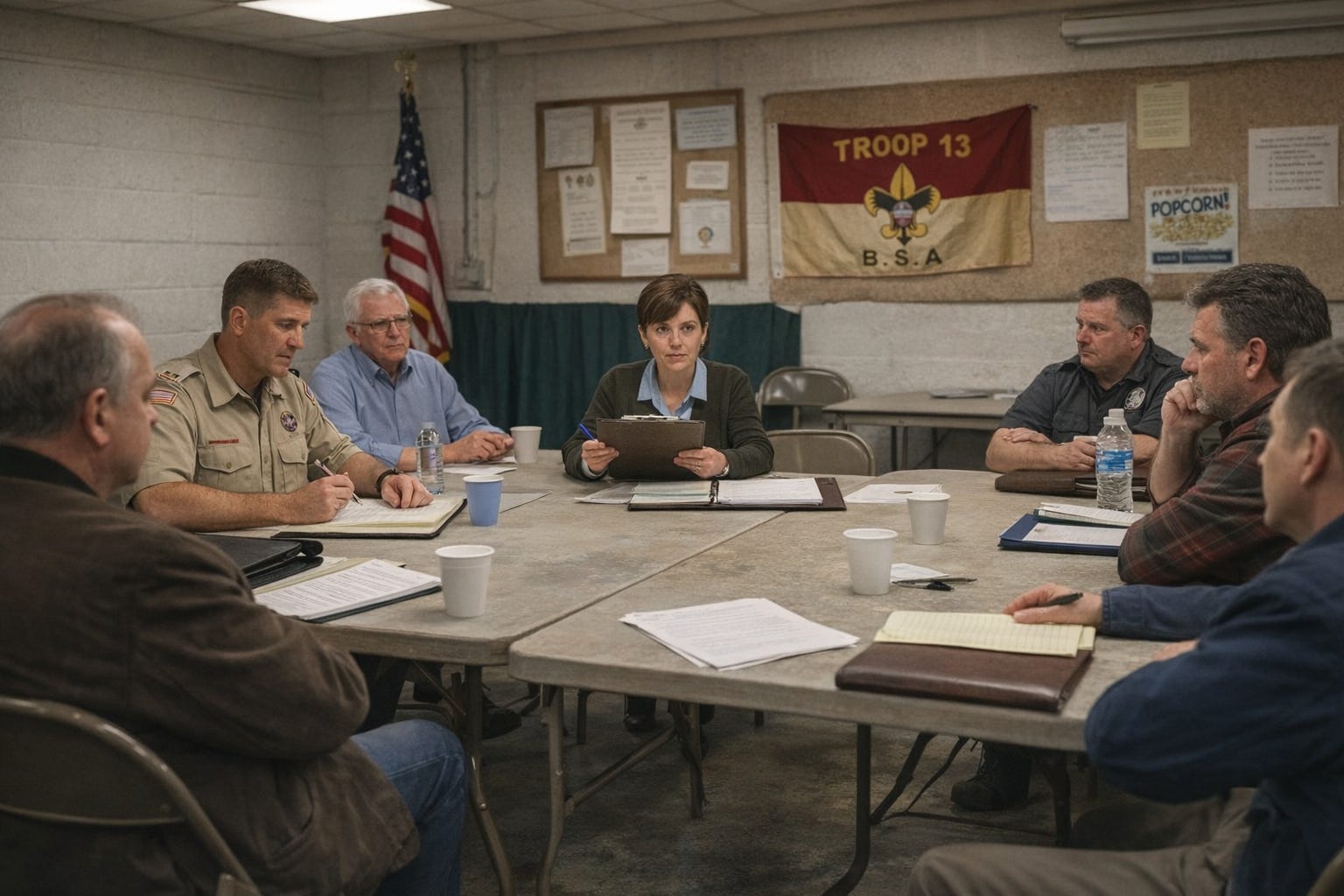
The committee met on a Thursday evening in the back room of the Presbyterian church and removed Stash Stapanski as scoutmaster of Troop 13 in eleven minutes. Karen McKay had prepared an agenda. The agenda had three items: the incident at the crossing-over ceremony, the DUI arrest, and the selection of a replacement. Items one and two took four minutes combined because there was nothing to discuss. Glen Harriman had driven down from the council office to deliver his report in person, which was unusual and which everyone in the room understood to mean that the situation was beyond the point where a phone call would do. He read from his notes. He described what he had witnessed at the VFW. He used the phrase “incompatible with the values of the Scouting program” twice. Karen thanked him. The committee voted. Stash was out.
Item three was harder.
Karen had anticipated this. She had a list of names, written on an index card in her compact, angular handwriting, each name followed by a brief annotation that no one else was meant to see. She read the names aloud without the annotations. Four men. One was a committee member’s brother-in-law who had been an Eagle Scout in the 1990s and lived two towns over. One was a father of a scout who worked nights and couldn’t commit to Tuesday evenings. One was a retired teacher who had expressed mild interest three years ago and had not been heard from since. One was Nick Testa, the officer who had arrested Stash, whom Karen had included because he was the most qualified person she could think of and because she believed in being thorough even when she already knew the answer.
None of them said yes. The brother-in-law didn’t return the call. The night-shift father said he wished he could. The retired teacher said he’d moved to South Carolina. Nick Testa said no in a way that sounded like a man closing a door and locking it behind him.
The committee agreed to wait. The next troop meeting was in two weeks, and three new families were expected from the crossing-over. Karen suggested they use the meeting to identify potential candidates among the incoming parents. She said this with confident, the way she always was when problems presented themselves—she had solved them before and she would solve this one, though the truth was simpler than that. She had no other options and she knew it.
Glen Harriman, before he left, raised one possibility. Stash could remain as an assistant scoutmaster. He had the training, he knew the boys, and most importantly he could accompany the troop on campouts, which was a practical necessity since you couldn’t send an untrained scoutmaster into the woods alone with twelve boys. Karen didn’t like it. She said so with her posture rather than her words. But she agreed, because Karen McKay was, above everything else, practical. The troop needed a functioning adult in the field, and Stash Stapanski was as close as they were going to come to having one. He knew which end of a compass pointed north. That would have to be enough.
The meeting hall was in the basement of the church, down a flight of stairs that smelled like old carpet and lemon cleaner. It was a long, low-ceilinged room with cinder block walls painted the color of something that had once been white and had given up. Fluorescent lights hummed overhead. An American flag stood in one corner. A troop flag, faded and slightly crooked on its pole, stood in the other. Between them, a corkboard displayed a calendar from two months ago, a flyer for a popcorn sale that had already ended, and a photograph of the troop from what appeared to be the previous decade, based on the haircuts. Metal folding chairs were arranged in a semicircle.
Corey arrived with Scott at six forty-five, fifteen minutes early, because Corey was the kind of person who arrived fifteen minutes early for everything, including things he didn’t fully understand. Scott was in his new Boy Scout uniform, purchased by Lura over the weekend from the Scout shop in the mall. The uniform fit. The shirt was tucked in. The belt was threaded through the loops. Scott looked like a boy who had been dressed by his mother, which he had been, and he carried the self-consciousness of someone wearing new clothes in front of people who would know they were new.
The room was not empty. Three boys were already there, sitting on folding chairs along the back wall, doing things on their phones with the total absorption of people who had no interest in where they were. They were older, maybe fourteen or fifteen, and they wore their uniforms with the comfortable looseness of boys who had long ago stopped caring whether their shirts were tucked in. One of them looked up when Corey and Scott walked in, assessed them with the instant and merciless calculus of adolescence, and returned to his phone.
A man emerged from a side door carrying a plastic bin full of what appeared to be rope. He was in his sixties, thin, with wire-rimmed glasses and a uniform that had been washed so many times the khaki had faded to the color of weak tea. This was Herb Ostrowski, the troop’s advancement coordinator, a man who had been involved with Troop 13 since before anyone currently in the room could remember, including Herb. He served no clearly defined function beyond appearing every Tuesday with a bin of rope and a willingness to teach any boy who asked how to tie a bowline. No boy had asked in over a year, but Herb kept bringing the rope.
“New scout?” Herb said, looking at Scott.
“First meeting,” Corey said.
Herb nodded. “You’ll want to talk to Karen. She’s upstairs.” He set the bin on the floor near the flag. “Karen runs things.”
This was, Corey would learn, the most concise and accurate description of Troop 13 that anyone had ever offered.
By seven o’clock the room had reached its Tuesday-night capacity of twelve boys and a handful of adults. The older scouts had put their phones away because Karen McKay had come downstairs, and when Karen McKay entered a room, phones disappeared the way small animals disappear when a hawk crosses the sky. She carried a clipboard and a folder and a plastic bag containing what turned out to be nametags for the new scouts, which she had printed on a label maker at home and cut to identical dimensions. She wore no uniform. Committee chairs were not required to. But she dressed for meetings with a formality that suggested she considered the absence of a uniform to be an oversight in the bylaws rather than a choice.
Karen took her position at the front of the room, to the right of the American flag, and called the meeting to order at seven o’clock exactly. Not seven-oh-one. Not six-fifty-nine. Seven. The boys stood. They recited the Pledge of Allegiance. They recited the Scout Oath. They recited the Scout Law. Karen watched them the way a conductor watches an orchestra, noting which mouths were moving and which were not.
There was no scoutmaster to run the meeting, so Karen ran it. She had prepared an agenda, because Karen always prepared an agenda, and she moved through it with the efficiency of a person who believed that idle time was moral failure. Patrol reports. Advancement updates. A reminder about the upcoming campout, which she acknowledged would depend on having adult leadership in place, a phrase she delivered without looking at anyone in particular and which landed on the room with the weight of an assignment no one had volunteered for.
Corey sat in one of the metal chairs along the wall, in the row designated for parents who were watching but not participating. Scott had been absorbed into the group of boys, seated in the semicircle with a nametag on his chest that read SCOTT in Karen’s block letters. He looked small in the circle. The other boys were talking to each other with the ease of shared history, and Scott was sitting with his hands in his lap, listening, not yet part of whatever they were part of.
The other new families arrived in the way that people arrive at unfamiliar places: tentatively, reading the room before committing to it.
Maria came through the door at seven-fifteen with a boy at her side and the visible arithmetic of exactly how late she could be before it became a problem. The boy was small for his age, with dark eyes and a quiet watchfulness that suggested he was used to observing before participating. His uniform was not new. The shirt had the softness of something that had been worn before, possibly by an older sibling, possibly purchased secondhand. His nametag, which Karen had also prepared, read DIEGO. Maria herself was in her late thirties, with her hair pulled back and the kind of face that would have been beautiful if it weren’t so tired. She found a chair along the wall near Corey, sat down, and exhaled in a way that suggested sitting down was something she didn’t get to do very often.
“First meeting?” Corey asked.
“First meeting,” Maria said. She looked at the room, at the boys, at Karen running things at the front. “Which one is yours?”
“Scott. The one who looks like he’s at a job interview.”
Maria smiled. It was a good smile, quick and real. “Mine’s Diego. The one who looks like he’s casing the place.”
They watched their sons together for a moment, the way parents do, with the particular solidarity of people who have brought their children somewhere new and are hoping it works out.
The third new scout arrived at seven-twenty, alone. He walked down the stairs and into the room without hesitation, as if he’d been coming here for years, which he hadn’t. He was a sturdy boy, light brown hair, wearing a uniform that fit properly and showed no signs of being new or borrowed or purchased secondhand. He signed himself in on the attendance sheet that Karen kept on a table by the door, found a seat in the semicircle, and sat down. His nametag read OWEN.
Corey looked toward the stairs. No one followed. He waited. No one came. Outside, through the narrow basement windows that looked out at ground level onto the church parking lot, he could see taillights pulling away. Whoever had brought Owen had not come in.
Karen noticed too. She made a note on her clipboard. She would follow up with Owen’s family, she was certain of that, because Karen McKay followed up on everything. But for now, the boy was here, and the meeting was in progress, and there were procedures to attend to.
After the meeting, while the boys milled around and Herb Ostrowski offered to show anyone who was interested how to tie a bowline (no one was interested), Karen moved through the room the way she always moved through rooms: with purpose, direction, and a clipboard that functioned as both tool and weapon.
She spoke to Maria first. The conversation was brief and diagnostic. Karen asked about Diego’s Cub Scout experience (he’d been in a pack across town), about whether Maria would be able to volunteer with the troop (Maria’s face performed a complex series of expressions that communicated the impossibility of this without saying it), and about whether there were other adults in the household who might be available (there were not). Karen processed this information with a series of small nods, thanked Maria, and moved on in a way that was polite and final, the way a person moves on from a door they’ve decided not to open. Maria had five children. Karen could do the math.
She spoke to Owen, since there was no parent to speak to. Owen was polite, direct, and gave answers that were complete without being expansive. He’d been in Cub Scouts. He’d earned his Arrow of Light. His parent couldn’t make it tonight but had filled out the registration online. Karen asked which parent. Owen said “my dad” in a tone that did not invite follow-up questions. Karen noted this. She would follow up anyway. That was what Karen did.
Then she turned to Corey.
He was standing near the coat hooks by the stairs, waiting for Scott to finish a conversation with Diego. The two boys had found each other in the way that new kids find each other: not through shared interests or natural chemistry, but through the mutual recognition that they were both new and therefore had no one else. They were talking about something on Diego’s phone. Scott was almost smiling, which for Scott was the equivalent of another boy’s cartwheel.
Karen approached with her clipboard at her side.
“Mr. Whitman. Thank you for bringing Scott tonight.”
“Corey,” he said. “Please.”
“Corey.” She said it as if she were filing it. “What do you do for work?”
“I teach at the community college. Art.”
“Art,” she repeated, in a tone that was not dismissive but was not enthusiastic, the tone of a person who has heard a word and is deciding where to put it.
“Visual arts, mostly. Drawing, painting, some design.”
“Were you in scouts as a boy?”
“No. I wasn’t.”
“Did your father do scouting?”
“My father was not really an outdoor person.”
Karen nodded. Corey could see her working through the checklist in her head, and he could see the results were not encouraging. No scouting background. No outdoor experience. An art professor. He was failing a test he hadn’t known he was taking, and the strange thing was that he could feel it happening and didn’t know how to change it, because the answers were the answers and he had no others to offer.
But Karen was not finished. “How’s Scott adjusting? To the transition from Cub Scouts.”
“I think he’s finding his way. He’s a little quiet. It takes him a while to warm up to new things.”
“That’s not unusual,” Karen said. “The transition can be difficult. Cub Scouts is very parent-driven. Boy Scouts is boy-led. The boys are expected to do more for themselves.” She paused. “Does Scott’s mother have any involvement?”
“Scott’s mother and I are divorced. She’s remarried. She’s been very supportive of his scouting, she’s the one who signed him up originally.”
Karen absorbed this without visible reaction. She was good at absorbing things without visible reaction. It was, Corey would later realize, her primary skill.
“Would you be available on Tuesday evenings?”
“I teach late on Mondays and Wednesdays, but Tuesdays are usually free.”
“And weekends? Occasional weekends. The troop does a campout roughly once a month during the school year and a week of summer camp in July.”
“I could make that work. Most of the time.”
Karen looked at him. It was a look that Corey would come to know well over the next two years, a look that contained assessment, calculation, and something that was not quite approval but was adjacent to it, the way a house is adjacent to the house next door. Close, but not the same thing.
“The troop needs a new scoutmaster,” she said. “I’m sure you’re aware of the circumstances.”
Corey was aware of the circumstances. Everyone who had been at the VFW was aware of the circumstances. What he was not aware of was that this conversation had been building toward this sentence since Karen said his name.
“I’m not sure I’m qualified,” he said, which was honest.
“The position requires a background check, Youth Protection Training, and completion of Scoutmaster Specific Training. All of that can be done in the first sixty days. The council has approved Stash Stapanski to serve as assistant scoutmaster, which means you’ll have an experienced adult with you on campouts.” She held up the folder she’d been carrying. “This is the scoutmaster binder. It has the troop’s charter, the calendar, the advancement records, and the guide to the training you’ll need to complete.”
She was holding it out to him. She was holding it out to him before he had said yes, because Karen McKay did not wait for people to arrive at conclusions she had already reached. The binder was thick. It had labeled tabs.
“It’s a lot of responsibility,” Corey said.
“It is.”
“And I have no experience.”
“You don’t.”
“And you think I should do it.”
Karen’s expression performed a subtle adjustment, a fraction of a degree, the kind of change you would only notice if you were the sort of person who noticed small changes in faces, which Corey was. It was not a smile. It was the ghost of a concession.
“I think you’re available on Tuesdays,” she said.
Corey looked at the binder. He looked at Scott, who was still talking to Diego by the coat hooks. He looked at Karen, who was holding the binder with both hands and waiting with practiced patience, having learned that silence, applied at the right moment, was more persuasive than any argument.
He took the binder. It was heavier than he expected.
“Scott’s going to love this,” he said.
Karen did not reply to this. What she said was: “The committee meets the first Thursday of every month. The training registration is in the binder under the green tab. I’d like you registered by the end of the week.”
She was already moving back toward the front of the room, her clipboard restored to its position in front of her chest, her posture as straight as the flagpole she was walking toward. The conversation was over. The decision had been made. Corey stood by the coat hooks with a three-inch binder in his hands and the dawning understanding that his Tuesday nights had just been claimed by a woman with labeled tabs and a will that could bend rebar.
Danny was on the couch in gym shorts and a tank top, eating microwave popcorn and watching a home renovation show he would deny watching if anyone asked. He had his feet on the coffee table and a beer sweating on a coaster that Corey had bought because Danny would not use a coaster unless there was a coaster to use.
Corey came through the door carrying the binder. He set it on the kitchen table, where it landed with a thud that made Danny look up.
“What is that?”
“I’m the new scoutmaster of Troop 13.”
Danny stared at him. Then he looked at the binder. Then back at Corey. “You’re kidding.”
“I’m not kidding.”
“The troop with the karaoke guy?”
“The karaoke guy has been demoted. He’s my assistant now.”
Danny set the popcorn on the coffee table and sat up, which was, for Danny, a gesture of serious attention. “Corey. You’ve never been camping. You don’t own a pair of boots. You cried during Into the Woods.”
“That’s a musical. That doesn’t count.”
“You cried during the intermission.”
“The Baker’s Wife had just died. Anyone would cry.”
“You brought tissues. You knew you were going to cry. You planned for it.” Danny picked up his beer and took a long pull, studying Corey with the evaluative eye of three years of living together, thinking he’d seen everything. “Who asked you to do this?”
“The committee chair. Karen.”
“The intense lady from the camping store?”
“That’s the one.”
Danny shook his head slowly. “And you said yes.”
“I said yes.”
“Why?”
Corey opened the binder. The first page was a table of contents, typed, with the kind of formatting that suggested the person who created it had opinions about font sizes. He turned past it to the calendar. April through March. Campouts, meetings, service projects, summer camp. A year of Tuesday nights and Saturday mornings, laid out in a grid that looked, from a distance, like a sentence he’d agreed to serve.
“Scott was talking to a kid after the meeting,” Corey said. “Diego. Maria’s boy. They were looking at something on Diego’s phone and Scott was almost smiling. You know how he gets. He doesn’t just walk into things. He stands at the edge and watches, and if he decides it’s safe he puts one foot in.”
Danny waited.
“He had one foot in tonight. I could see it. And I thought, if I’m there, if I’m the one running it, maybe he puts the other foot in too.”
Danny looked at him for a long moment. Then he picked up his popcorn and leaned back into the couch. “You’re going to have to buy boots.”
“I know.”
“Good boots. Not the kind that look good. The kind that work.”
“I understand the distinction.”
“You say that, but you bought a camp chair based on the color.”
“The color was a factor.”
“The color should never be a factor in a camp chair, Corey.”
He called Lura after Scott was asleep. She answered with the warm, slightly distracted tone of a woman who was doing three things at once, which she usually was.
“How was the meeting?” she asked.
“I’m the new scoutmaster.”
A pause. Then Lura laughed, not at him, but with the surprised delight of someone who has heard something unexpected and is deciding how much she loves it. “You’re serious.”
“Apparently.”
“Corey, that’s wonderful. Scott must be thrilled.”
“I haven’t told him yet. I wanted to sit with it for a night.”
“Sit with it how?”
“I don’t know what I’m doing, Lura.”
There was a softness in her voice when she spoke next, the particular gentleness of someone who has known you long enough to see the doubt underneath the decision. “You didn’t know what you were doing when you started teaching either. You figured it out. You always figure it out.”
“Teaching is different. I went to school for teaching.”
“You went to school for art. You figured out the teaching part on your own.”
He wanted to argue with her but couldn’t, because she was right, and because Lura had the inconvenient habit of being right about him more often than anyone else. They had been married for eight years and divorced for four, and in those four years she had become something more useful to him than a wife: an honest observer. She knew where his confidence failed. She knew where it shouldn’t.
“The committee chair handed me a binder,” he said. “It has tabs. Color-coded tabs.”
Lura laughed again. “I like her already.”
“You would not like her. She’s terrifying.”
“The terrifying ones are usually the ones holding everything together.”
Corey looked at the binder on the kitchen table. In the living room, Danny had fallen asleep during his renovation show, the remote balanced on his chest, the television casting blue light across a face that was not troubled by anything. From Scott’s room, which was really the second bedroom that became Scott’s room every other weekend, there was silence. The boy was asleep. The apartment was still. And on the table, between a stack of student portfolios and a coffee mug with a Sondheim quote on it, sat a three-inch binder with color-coded tabs that represented a commitment Corey did not fully understand and could not take back.
“He’ll be so proud of you,” Lura said. “You know that, right?”
“I hope so.”
“I know so. Good night, Corey.”
“Good night.”
He hung up. He sat at the kitchen table and opened the binder to the green tab, which was labeled TRAINING REQUIREMENTS. There were forms. There were checklists. There were acronyms he didn’t recognize and procedures he couldn’t visualize and a paragraph about something called the “patrol method” that he read twice and understood less the second time. He took out a pen, the same felt-tip he used for grading portfolios, and began making notes in the margins. Small notes. Careful questions. The handwriting of a man who did not know where he was going but intended to pay attention on the way there.
In the living room, the television murmured. Danny snored softly. Outside the apartment, the town was still.
Corey turned the page.
This is fabulous! I can't wait till Karen finds out. 😂
I thoroughly enjoyed this.