

Wood Badge

The parking lot was full of men in khaki who looked like they had been in khaki their entire lives.
They stood beside trucks and SUVs, unloading gear with the purposeful efficiency of people who had packed for this kind of weekend many times before. Their packs were organized. Their boots were broken in. They greeted each other with handshakes and first names and the easy familiarity of men who had met at roundtables and camporees and district dinners and who occupied the same narrow world of volunteer scouting leadership, a world that had its own vocabulary and its own hierarchy and its own unwritten rules about who belonged and how you proved it.
Corey pulled into the lot in his Subaru and sat for a moment with the engine running. He was wearing his uniform. The uniform fit well because Corey’s clothes always fit well, and the neckerchief was tied in a knot he had learned from a YouTube video because the knot in the handbook was illustrated by someone who believed that line drawings were an adequate substitute for instruction, and Corey, who had spent his career teaching people to see, knew they were not.
Wood Badge. The words carried weight in scouting the way certain degrees carry weight in academia: not everyone had done it, the people who had done it talked about it with a reverence that bordered on the religious, and the people who hadn’t done it were divided between those who intended to and those who thought the whole thing was overblown. Corey had intended to from the moment Gary Furlong had mentioned it at his first training weekend, a year and a half ago, in a room full of men named Gary who had opinions about lashing techniques. Gary had said, “If you’re serious, you do Wood Badge.” Corey was serious.
The course was five days, split across two weekends, at a council camp an hour north. Participants were divided into patrols. The patrols had animal names. There would be lectures and discussions and outdoor challenges and a leadership project that each participant would complete over the following months. At the end, you received beads. Two wooden beads on a leather thong, worn around the neck, the physical evidence of completion, the scouting equivalent of a doctoral hood. Corey wanted the beads. He was not ashamed of wanting them. He had spent two years earning things—ranks, awards, patches, the respect of boys and the grudging tolerance of Karen McKay—and the wanting was the engine that had carried him from a VFW parking lot to this parking lot, from a man who did not know what a patrol method was to a man who ran one.
He got out of the car. He shouldered his pack. He walked toward the registration table, where a woman with a clipboard was checking people in, and the clipboard made him think of Karen and the thinking of Karen made him smile, which was not the usual result of thinking about Karen but which happened because he was here, at the thing Karen valued most, and Karen did not know he had registered, and the not-knowing was a small, private pleasure he intended to deploy at the correct moment.
* * *
His patrol was the Bobwhites.
There were eight of them. Corey assessed his patrol the way he assessed any group he was about to spend time with: by watching. There was Ray, who was retired Army and who stood the way retired Army stands, which is permanently. There was Mike, who was a contractor from the eastern part of the state and who had hands like baseball gloves and a voice that could carry across a construction site without effort. There was Sandra, a den leader from a suburban pack who had brought color-coded binders and who was, Corey recognized immediately, a Karen in a different uniform. There was Tom, who was quiet and who taught high school history and who sat in the back of the room the way Corey sat in the back of rooms, observing before committing. There was Dave, who sold insurance and who talked about selling insurance more than anyone wanted to hear. And there were two others whose names Corey would learn by the end of the first day and whose personalities would emerge by the end of the second, the way personalities emerge in any group that is forced into proximity and given a shared task.
The course director was a man named Frank Oteri, who had been doing this for fifteen years and who opened the first session by standing in front of fifty adults and saying, “Forget everything you think you know about leadership,” which was the kind of thing people said at the beginning of courses and that usually preceded a PowerPoint presentation that contradicted the instruction. Frank did not have a PowerPoint. Frank had a whiteboard and a marker and a way of looking at a room that suggested he could see every person in it simultaneously and that he was not particularly impressed by any of them yet.
“Leadership,” Frank said, “is not about being in charge. It’s about making the people around you better at the thing they’re already trying to do. If you leave this course thinking leadership means giving orders, I’ve failed and you’ve wasted a weekend.”
Ray, the retired Army, shifted in his seat. Ray had spent thirty years in a system where leadership meant exactly giving orders, and the suggestion that it might mean something else was landing in his body before it reached his brain.
Corey wrote it down. He wrote everything down. He had brought his good notebook, the one he used for course planning, and he was writing in it with the same focus he brought to faculty meetings and student critiques and Tuesday night troop meetings, the focus of a man who believed that the distance between hearing something and knowing it was the width of a pen.
* * *
On Saturday afternoon they went outside.
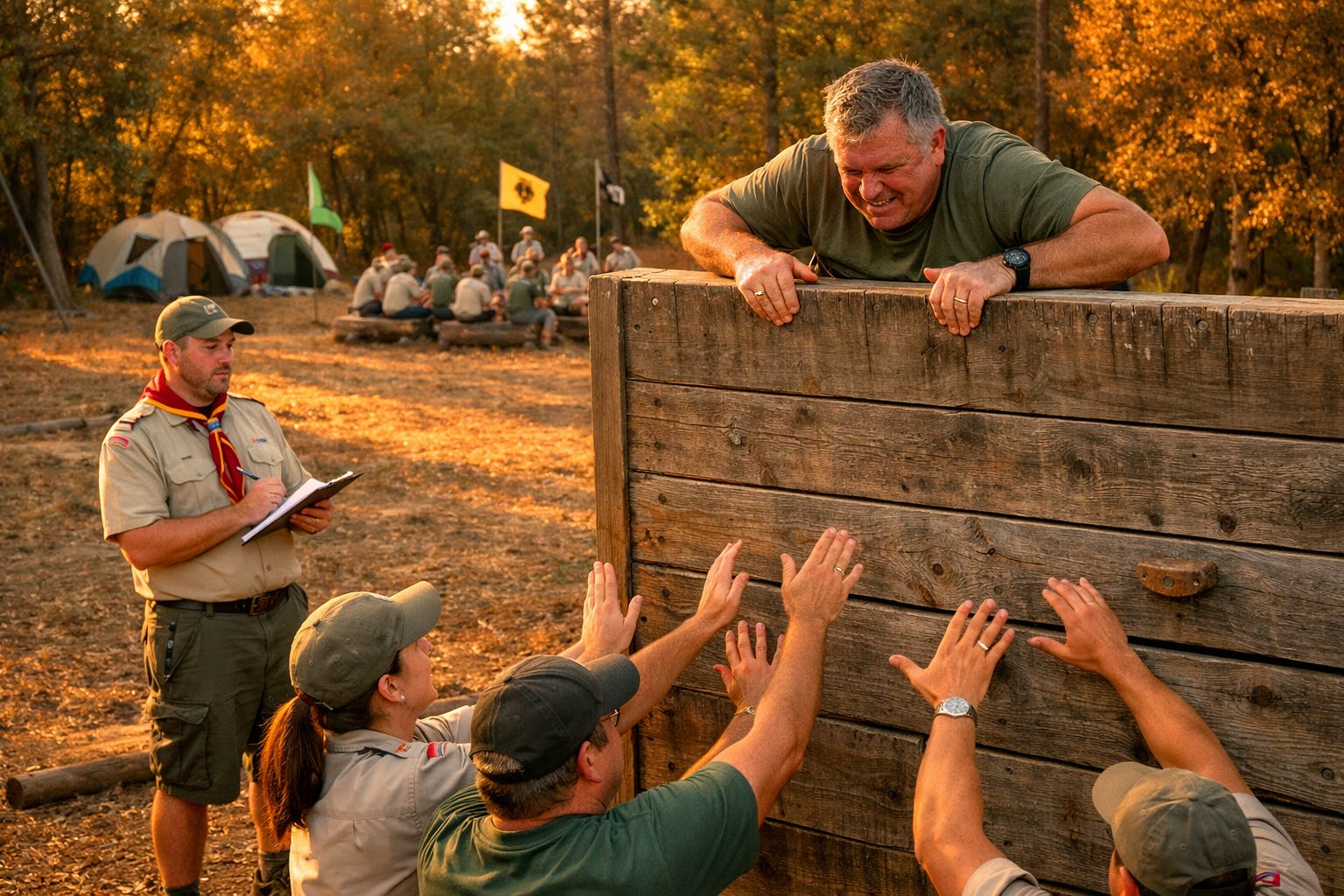
The challenge was a ropes course and a series of team problems: the kind of exercises where a group must move a bucket of water across a field using only two poles and a rope, or build a structure from random materials, or get every member of the patrol over a wall that is taller than any individual member. The exercises were designed to reveal leadership styles under pressure, which they did, immediately and without mercy.
Ray took charge. Ray took charge because Ray had always taken charge and because the wall was a problem and problems, in Ray’s experience, were solved by a man who pointed at things and said go. He pointed at the wall. He said go. Mike, the contractor, went, because Mike was large and strong and going over walls was something his body understood. Sandra began organizing the remaining members into a sequence based on height and weight, her color-coded binder having been replaced by a color-coded mental spreadsheet that was no less organized for being invisible.
The first three people went over the wall. The fourth, Tom, did not. Tom was fifty-three and had a bad knee and the wall was eight feet tall and Tom stood at the base of it and looked up and the looking up was the problem, because the wall was not actually the obstacle. The obstacle was the moment between deciding to go and going, the moment where the body asks the mind whether this is serious and the mind has to answer.
Ray said, “Come on, Tom, we’re on the clock.”
Tom did not come on. Tom stood at the wall and the clock ran and Ray said “come on” two more times with increasing volume, as if the problem were acoustic rather than psychological, and Corey, who had been standing at the edge of the group watching, stepped forward.
He did not step in front of Ray. He stepped beside Tom. He did not say come on. He said, “What do you need?”
Tom looked at him. “My knee,” Tom said. “I can’t push off.”
“If we make a step, a boost, can you pull yourself up from the top?”
“Yeah. I can pull. I just can’t push.”
Corey looked at Mike. “Mike, can you make a stirrup?” Mike cupped his hands. Corey said to Tom, “Step into Mike’s hands, we’ll boost you to where you can reach the top, and you pull from there.”
Tom went over the wall. It was not graceful. It was not fast. It was a fifty-three-year-old man with a bad knee getting over an eight-foot wall because someone had asked him what he needed instead of telling him to hurry up, and Frank Oteri, watching from thirty feet away with his arms crossed, made a note on his clipboard.
Afterward, in the debrief, Frank asked the patrol what had happened at the wall. Ray said they’d gotten everyone over. Sandra said the sequencing could have been more efficient. Dave, who had talked about insurance for two days straight, said nothing.
Frank looked at Corey. “What did you do at the wall?”
“I asked Tom what he needed.”
“Why?”
“Because telling him to hurry up wasn’t solving the problem. The problem wasn’t speed. The problem was that he couldn’t push off his knee, and nobody had asked him why he wasn’t moving.”
Frank nodded. He turned to the group. “That’s the course. Everything else I’m going to teach you this weekend is a longer version of what just happened. Someone couldn’t get over the wall. One person told him to go faster. Another person asked him what he needed. Leadership is the second one.”
Ray looked at Corey. The look contained several things: surprise, reassessment, and the particular discomfort of a man who has been doing something one way for thirty years and has just watched someone do it better in thirty seconds. Ray did not say anything. He didn’t need to. The wall had said it.
* * *
Saturday night, after the evening session, Corey sat on the porch of the cabin and called Jennifer.
“How’s scout camp for adults?” she said.
“It’s not camp. It’s a leadership course.”
“You’re sleeping in a cabin in the woods on a Saturday night. It’s camp.”
“The cabins have electricity.”
“Camping with a plug. Very rugged.”
He told her about the wall. He told her about Tom and Ray and the question he had asked. He told her about Frank’s debrief, how Frank had used the moment to teach the entire room.
“You know what you did, right?” Jennifer said.
“I asked a question.”
“You did the thing you do. You saw what the actual problem was. Not the wall. The knee. You do it with your students. You do it with the scouts. You did it with Scott when he was homesick at camp.” She paused. “You’ve been doing it your whole life, Corey. This course isn’t teaching you anything. It’s giving you the vocabulary for what you already do.”
Corey sat on the porch in the dark and listened to the trees and felt something he could not name, something that was not pride exactly but was in the territory of pride, the territory where a man realizes he has been good at something without knowing it and that the knowing does not change the thing but changes how he carries it.
“How’s Tyler?” he asked.
“Tyler ate a pinecone today.”
“Why.”
“He said he wanted to know what it tasted like. I said now you know. He said it tasted like a tree. I said what did you expect. He said he didn’t have expectations, he had curiosity.”
“He’s twelve.”
“He’s Tyler.”
Corey laughed. He said goodnight. He sat on the porch a while longer. Inside the cabin, Ray was already asleep. Tom was reading. Through the screen he could hear Sandra organizing something, the sound of someone who could not stop arranging the world into categories, and Corey felt the specific tenderness he felt for all the Karens and Sandras, the people who held things together by holding them too tightly, who gripped the clipboard because the clipboard was the only thing between them and the fear that the thing they loved would fall apart if they loosened their hands.
He thought about Karen. He thought about her finding out he was here, at Wood Badge, the course she valued most in the scouting universe. He thought about what it would mean to her: that the man she had recruited out of desperation, the man she had watched with suspicion and assessed with her clipboard and tolerated because she had no alternative, had chosen, voluntarily and at his own expense, to complete the highest training scouting offered. He could not predict her reaction. Karen’s reactions were not predictable in the way that weather is not predictable: you could read the conditions and make an educated guess, but the storm went where the storm went.
He went inside. He lay in his bunk and listened to the cabin settle. Tomorrow was the second day. There would be more lectures, more exercises, more moments where Frank would point at a thing that had just happened and say, that’s the course. And Corey would write it down. And the writing would be the thing between hearing and knowing, the width of a pen, the distance he had been closing for two years.
* * *
On Sunday afternoon, Frank stood in front of fifty adults and handed out patrol assignments for the second weekend. He reviewed the leadership project requirements: each participant would design and execute a project in their home unit, something that demonstrated the principles of the course, and the project would be evaluated and the evaluation would determine whether they received their beads. The beads were not given. The beads were earned. Frank made this distinction clearly and without apology.
He dismissed them. People shook hands and exchanged numbers and loaded their cars and drove home to their troops and their dens and their packs, carrying the weekend in their notebooks and their bodies and the particular fatigue of people who have spent two days learning something that matters.
Corey drove home. He drove south through the October trees, the leaves at peak, the hills burning orange and red in the late afternoon light, and he thought about the wall and the question and the beads he had not yet earned and the troop meeting on Tuesday where he would walk into the church basement and run a meeting for fifteen boys and nobody would know he had spent the weekend learning to be better at the thing he was already doing, except that he would know, and the knowing would live in every meeting and every campout and every campfire from now until the beads were around his neck.
His phone buzzed. A text from Karen: “I hear you’re at Wood Badge.”
Of course she knew. Karen knew everything. Karen knew things before they happened, or she knew them as they happened, through a network of information sources that Corey had never mapped and that operated with the efficiency of a intelligence apparatus run by a woman who had been doing this for twelve years and who considered information a natural resource to be harvested.
He waited for the follow-up. He waited for the assessment, the qualification, the Karen sentence that would take a good thing and examine it under a light that revealed every flaw. He watched his phone. Three dots appeared. Three dots disappeared. Three dots appeared again.
Then: “Good.”
One word. No period. No follow-up. No qualification. From Karen McKay, a woman who had never used one word when twelve would do, a woman who appended conditions to compliments and footnotes to praise, who hedged every positive statement with a clause that began with “but” or “however” or “that said.”
Good.
Corey drove south through the burning trees and held the word the way you hold a small, unexpected thing that has been handed to you by a person you did not expect to hand you anything, and the word was warm, and the trees were on fire, and the road went home.